

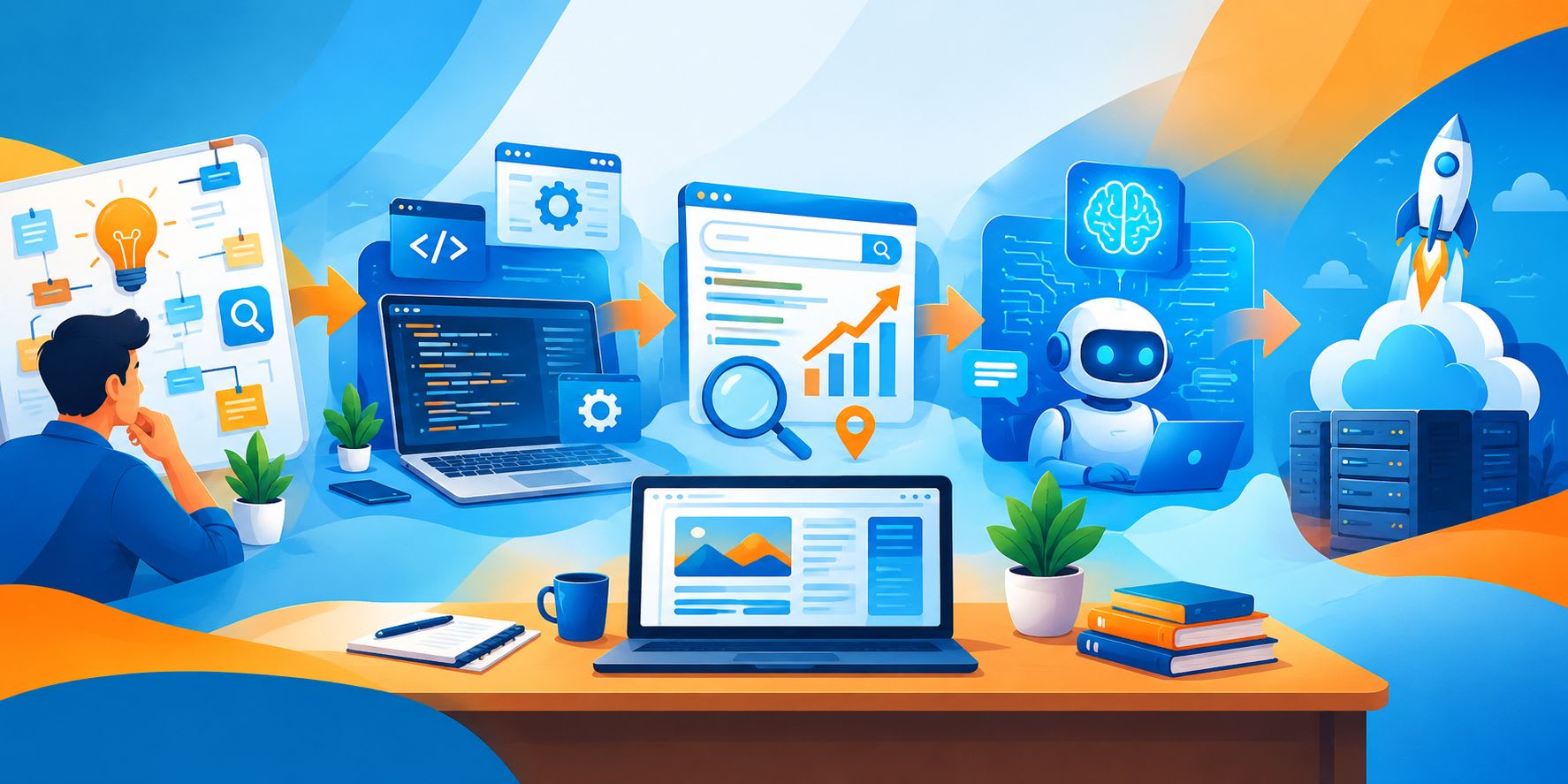
From Discovery to Deployment Web Development, SEO, and AI
From Discovery to Deployment: Connecting Web Development, SEO, and AI Features
Modern website projects rarely involve development alone. A useful site may need clear information architecture, search visibility, fast performance, analytics, automation, and increasingly some form of AI-assisted functionality.
The challenge is that these areas are often handled separately. Developers build pages, SEO work begins later, AI features are added as experiments, and performance problems are discovered only after launch. A more effective approach connects these decisions from the beginning.
Start With Discovery, Not Development
Before choosing a framework, theme, plugin, or AI service, define what the website is expected to accomplish.
Identify the audience, primary actions, content types, important search topics, required integrations, and technical constraints.
A clear discovery phase reduces unnecessary development and helps prevent structural changes after launch.
Translate Business Goals Into Website Functions
A business goal such as generating leads should become specific website functions such as landing pages, forms, CRM integration, tracking, and follow-up automation.
A goal such as increasing organic traffic should translate into crawlable content, clear page relationships, internal linking, and measurable search performance.
Design Information Architecture Early
Site structure affects both users and search engines.
Define major categories, page types, URL patterns, navigation, and internal relationships before large amounts of content are created.
A predictable architecture is easier to crawl, maintain, and expand.
Map Search Intent to Page Types
Not every keyword deserves its own page.
Group related searches according to intent and determine whether they belong on a service page, article, category page, comparison page, product page, or another format.
This helps reduce thin or overlapping content.
Keep Research and Development Resources Easy to Revisit
Web projects often require switching between developer documentation, SEO tools, analytics platforms, design resources, hosting dashboards, AI services, and technical references.
For general navigation between frequently used online destinations, a reference point such as 주소사이트 바로가기 can help keep useful resources easier to revisit, while deployments, account access, billing, API credentials, and other sensitive operations should still be handled through verified official provider pages.
Choose the Technology Stack Around Requirements
The most popular framework is not automatically the right choice.
Consider content management, expected traffic, development resources, integrations, hosting requirements, editing needs, and long-term maintenance.
A simple content-focused site may need a very different stack from a complex web application.
Keep the Rendering Model in Mind
Server-rendered, statically generated, and client-rendered sites can all perform well when implemented correctly.
The important question is whether important content and links are reliably available to users and search engines.
Build Semantic HTML From the Start
Clear HTML structure supports accessibility, maintainability, and search understanding.
Use headings to represent content hierarchy, meaningful links for navigation, labels for forms, and appropriate structural elements instead of relying entirely on visual styling.
Do Not Treat SEO as a Plugin
SEO is influenced by architecture, rendering, content, speed, internal linking, server behavior, and metadata.
A plugin can help manage some elements, but it cannot repair a poorly planned site structure by itself.
Define Metadata Rules Before Scaling
Large sites should have predictable rules for titles, meta descriptions, canonical tags, social metadata, and indexation.
Templates reduce manual errors and make it easier to maintain consistency.
Keep Canonical URLs Predictable
Decide how the site handles www, HTTPS, trailing slashes, parameters, and duplicate page variations.
Redirects, canonical tags, internal links, and sitemap URLs should support the same preferred structure.
Plan Redirects During Development
If an existing website is being rebuilt, old URLs should be mapped before launch.
Waiting until after migration often leads to missing redirects and unnecessary 404 errors.
Preserve Valuable Existing URLs
Changing every URL during a redesign is rarely necessary.
If a page already has traffic, links, or history, keeping the same address may reduce migration complexity.
Build Internal Linking Into Templates
Important pages should not depend entirely on manual links added later.
Navigation, related content, category structures, and contextual components can help maintain consistent internal linking as the site grows.
Do Not Automate Irrelevant Links
Automated related-content systems should prioritize relevance rather than simply generating more links.
Too many weak relationships can make navigation less useful for both visitors and search analysis.
Plan AI Features Around a Real Task
Adding AI simply because it is available rarely improves a product.
Define the user problem first. AI might help with search, summarization, classification, recommendations, document analysis, support, or content assistance.
If a normal rule-based function solves the problem more reliably, AI may not be necessary.
Separate AI Assistance From Authoritative Data
Generated responses should not automatically replace verified business information.
For prices, policies, technical specifications, account data, or other important facts, AI features should use trusted sources or clearly indicate limitations.
Use Retrieval When Context Matters
An AI feature may perform better when it can retrieve relevant approved documents or database information before generating an answer.
This can be more reliable than expecting a general model to know project-specific details.
Control the Data Sent to AI Services
Before connecting an external AI API, determine what information will leave the application.
Avoid sending credentials, unnecessary personal information, confidential documents, or sensitive business data without an appropriate data-handling process.
Store API Keys Outside Client-Side Code
Private credentials should not be exposed in browser JavaScript or public repositories.
Use secure server-side configuration or an appropriate secret-management method.
Set Usage Limits
AI APIs can create variable costs.
Add rate limits, input limits, quotas, or other controls so that unexpected traffic does not produce uncontrolled usage.
Design for AI Failure
External AI services can time out, return errors, or produce unsuitable output.
A website should have a fallback path rather than becoming unusable when one AI request fails.
Measure Whether the AI Feature Helps
Track useful outcomes instead of assuming that a new AI feature improves the site.
Depending on the function, useful measures might include task completion, support resolution, search success, conversion, or reduced manual work.
Optimize Images During the Build
Performance work should not begin after design approval.
Use appropriately sized images, modern formats where suitable, responsive image delivery, and lazy loading for content that is not immediately visible.
Control JavaScript Growth
Modern websites can accumulate scripts from frameworks, analytics, chat tools, AI widgets, personalization, advertising, and experimentation platforms.
Review whether every script is necessary and when it needs to load.
Avoid Shipping Unused Code
A large library may provide many components while the site uses only a few.
Where the technology stack supports it, load only the functionality required by the page.
Monitor Third-Party Dependencies
External scripts can affect speed and reliability even when the site's own code is optimized.
Measure the impact of chat widgets, embeds, analytics tools, consent platforms, and AI integrations.
Build Accessibility Into Components
Reusable components should support keyboard navigation, logical focus order, appropriate labels, sufficient contrast, and understandable states.
Fixing accessibility at the component level is much easier than repairing the same problem across hundreds of pages later.
Test Forms Carefully
Forms are often central to conversions and user interaction.
Test validation, error messages, confirmation states, spam protection, email delivery, and integration with external systems.
Do Not Depend Only on Client-Side Validation
Important form data should also be validated on the server.
Client-side validation improves usability, but it should not be the only control.
Design Analytics Before Launch
If measurement is added only after deployment, important baseline data may be lost.
Define key events, conversions, page groups, campaign parameters, and other tracking requirements before the site goes live.
Track Actions That Matter
Page views alone may not explain whether the site is working.
Track meaningful interactions such as form submissions, sign-ups, purchases, downloads, or completed AI-assisted tasks where relevant.
Keep Analytics Implementation Manageable
Too many tags can create duplicate events, performance problems, and confusing reports.
Document what each tracking script does and remove outdated implementations.
Prepare a Staging Environment
A staging site provides a safer place to test design changes, AI integrations, redirects, plugins, and deployment configuration.
It should be clearly separated from production and protected from unintended indexing when appropriate.
Use Version Control
Code, configuration, and deployment-related changes should be traceable.
Version control makes it easier to review modifications and return to a previous state when a release causes problems.
Keep Secrets Out of the Repository
API keys, database passwords, and private credentials should not be committed to source control.
Use environment variables or a dedicated secret-management system.
Create Repeatable Deployments
A deployment should not depend entirely on someone remembering a long sequence of manual steps.
Automate repeatable processes where practical and document any steps that remain manual.
Separate Build and Deployment Configuration
Development, staging, and production environments may use different domains, databases, API keys, and service settings.
Keep environment-specific values separate from application logic.
Check Robots Controls Before Launch
Staging environments are often intentionally blocked from indexing.
One of the most important launch checks is confirming that production is not accidentally carrying over staging robots directives.
Validate Canonicals on Production
Preview or staging domains can accidentally remain in canonical tags after deployment.
Check representative production pages after launch.
Generate and Verify the Sitemap
The sitemap should contain intended canonical URLs and exclude obvious staging, broken, or duplicate addresses.
Regenerate it if the site structure changes significantly during deployment.
Test Redirects After Deployment
Migration redirect rules may behave differently on the production infrastructure.
Test important old URLs and confirm they reach the expected final destinations without unnecessary chains.
Check Server Response Codes
Important pages should return the expected status.
A visually working page can still return an incorrect server response that complicates crawling or monitoring.
Enable HTTPS Correctly
The production site should use a valid SSL certificate and consistent HTTPS URLs.
Test HTTP-to-HTTPS redirects and watch for mixed-content resources.
Plan Certificate Renewal
A certificate that works on launch day still needs to renew later.
Verify that automated renewal is configured and that required validation will continue to work.
Use Caching Intentionally
Browser, server, application, and CDN caching can improve performance, but overlapping cache layers can complicate debugging.
Understand what is cached and how it can be purged after deployment.
Do Not Cache Personalized Data Incorrectly
Pages containing account-specific, user-specific, or dynamic AI output may require different caching rules from public content.
Test personalized areas carefully before applying aggressive caching.
Add Monitoring Before Traffic Arrives
Uptime and application monitoring should be ready before launch.
It is much easier to diagnose a problem when response times, errors, and availability are already being recorded.
Watch Logs After Deployment
Application and server logs may reveal failed API requests, missing assets, unexpected redirects, permission problems, or database errors that are not obvious during casual browsing.
Monitor AI Costs and Errors
AI integrations should have their own operational monitoring.
Track request volume, failures, latency, token or usage consumption, and unusual spikes.
Review Search Performance After Launch
For migrations or redesigns, monitor indexing, impressions, clicks, landing pages, and coverage after deployment.
Unexpected changes can reveal redirect, canonical, rendering, or content problems.
Compare Important Pages Before and After
Keep a record of major URLs, titles, headings, canonical tags, status codes, and other key elements before a redesign.
This makes post-launch troubleshooting much easier.
Do Not Change Everything at Once
Combining a full redesign, new framework, domain change, URL migration, analytics replacement, and new AI platform in a single release makes problems harder to isolate.
Where practical, separate major changes into controlled stages.
Document Dependencies
A modern site may depend on hosting, DNS, CDN, databases, email services, payment providers, analytics, APIs, AI platforms, and third-party scripts.
Documenting those dependencies helps when an external service fails or needs to be replaced.
Create a Rollback Plan
Before a major deployment, determine how the previous version can be restored.
Keep backups, database snapshots, deployment history, and the configuration needed to return to a known working state.
A Practical Integrated Workflow
define business goals and user tasks
map information architecture and search intent
choose a technology stack that matches requirements
build semantic and reusable components
plan technical SEO before content scales
add AI only where it solves a defined problem
control data, API keys, and AI usage costs
optimize images, scripts, fonts, and third-party assets
define analytics and conversions before launch
test in staging and deploy through a repeatable process
validate redirects, canonicals, HTTPS, and indexability
monitor performance, errors, search visibility, and AI usage after launch
Integration Matters More Than Individual Features
A successful website is rarely the result of one framework, one SEO tool, or one AI feature.
Development decisions affect search visibility, SEO requirements influence architecture, AI features introduce new data and performance considerations, and deployment determines whether all of those systems work reliably in production.
When discovery, development, SEO, AI, measurement, and deployment are treated as parts of the same workflow, the site becomes easier to maintain, easier to improve, and better prepared for future changes.
Want to publish a guest post on aamax.co?
Place an order for a guest post or link insertion today.
Place an Order