

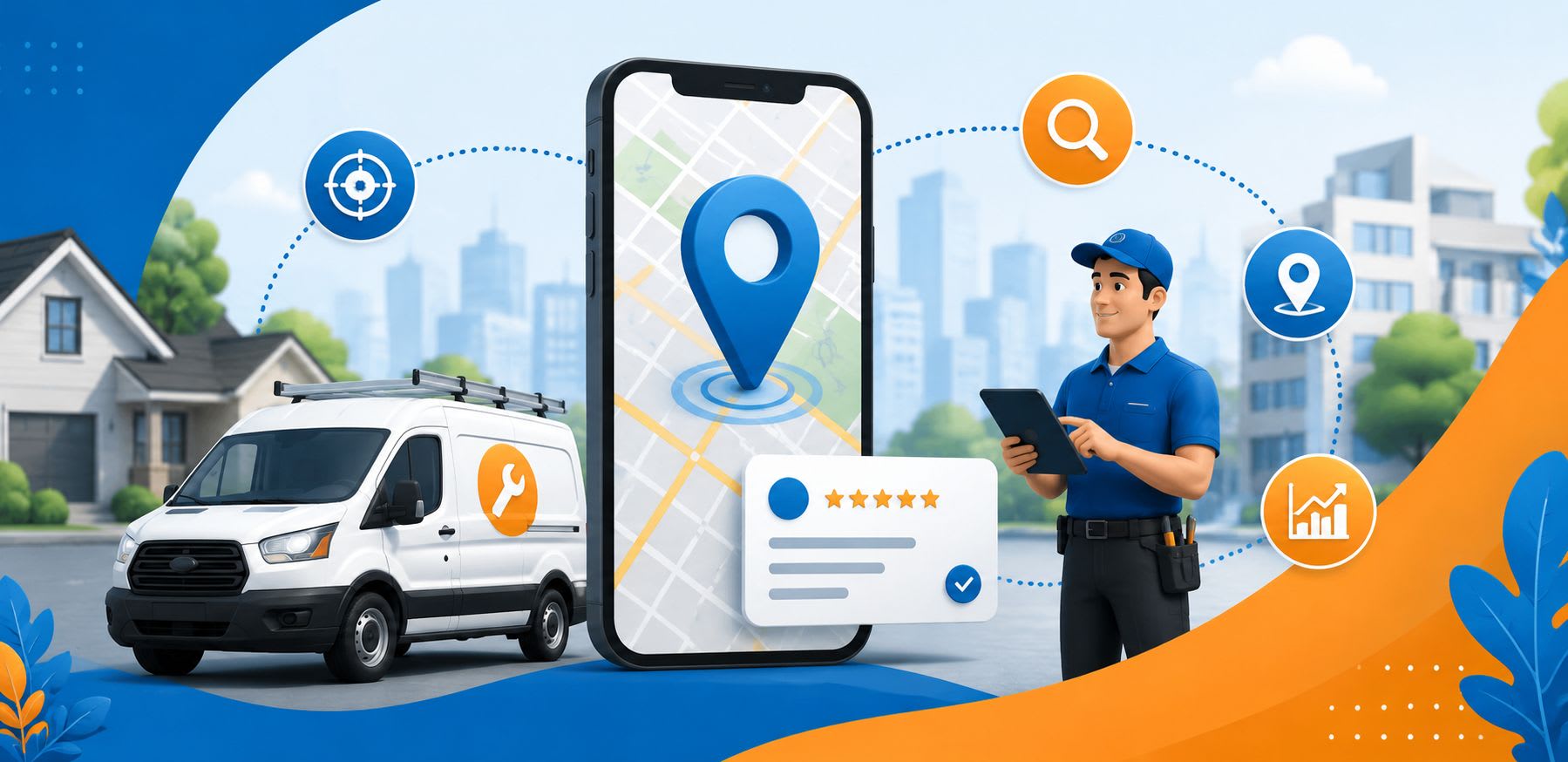
Local SEO for Mobile Businesses With No Physical Address
Not every business has a front door. Mobile groomers, roving coffee bars, on-site repair crews, pop-up clinics, and traveling consultants all serve real customers in real places, but none of them have a storefront a customer can walk into. That creates an awkward problem in local search, because most local ranking advice quietly assumes you have an address to optimize around. If you run a mobile operation, you need a different playbook.
Why Having No Address Changes the Local SEO Game
Local search was built around proximity. Search engines try to answer "who is near me and can help me right now," and the fastest way to answer that is to compare a searcher's location against a business address. When you remove the address from the equation, you remove the single strongest signal Google has for placing you on a map.
This does not disqualify you. It simply means the other signals have to carry more weight. Relevance, service area definition, reviews, content, and citations all have to work harder because distance is no longer the main factor.
The mistake most mobile operators make is treating this as a technicality to be worked around rather than a strategy to be built. They rent a mailbox, list a home address, or leave the profile half-configured and hope for the best. All three approaches tend to backfire. If you are still getting oriented on the fundamentals, the basics of local SEO and why it matters are worth reviewing before you start making changes, because most of the errors below come from applying storefront tactics to a business that does not have a storefront.
Treat Your Vehicle as Part of Your Local Footprint
For a mobile business, the vehicle is not just transport. It is your premises, your signage, your equipment storage, and often your only physical touchpoint with a customer. That gives it a role in local visibility that most operators underestimate.
A branded, well-equipped vehicle generates photo assets for your profile, produces the on-site imagery that makes reviews more credible, and creates genuine local visibility in the neighborhoods you serve. It also changes what you can honestly claim on your website. A plumber with a fully fitted van can describe a completely different service capability than one working out of a car boot, and that distinction shows up in the specificity of your service pages.
There is also a practical operational angle. Purpose-built conversions are increasingly used as full mobile workspaces rather than glorified toolboxes, and the benefits of a mobile business van extend beyond convenience into things that directly shape your local marketing, such as onboard power for equipment demos, secure storage that lets you take on higher-value jobs, and consistent branding across a growing fleet. The clearer your actual service capability, the easier it is to write location content that does not sound like filler.
Set Up Your Google Business Profile as a Service-Area Business
Google has a specific classification for businesses like yours. It is called a service-area business, and it exists precisely because millions of legitimate companies travel to their customers instead of the other way around.
A business without a storefront that travels to customers is entitled to one service-area profile, and that profile should hide the street address rather than display it. Under Google's guidelines for representing your business, Google also advises keeping your overall service area within roughly two hours of driving time from your operating base. That boundary is not arbitrary. It reflects what Google considers a plausible local footprint, and stretching well past it rarely produces rankings in those distant towns anyway.
Hiding the address is not optional if customers cannot visit you there. Displaying a residential address for a business nobody visits is one of the more common reasons profiles get suspended, and a suspension costs you far more visibility than a hidden address ever will.
Configure the Profile Completely
Once the address is hidden, everything else on the profile has to compensate. Choose the most specific primary category available rather than a broad one. Fill out every service you offer with real descriptions, not one-word labels. Add your operating hours, your attributes, and your business description.
Photos matter more here than they do for storefront businesses, because your vehicle and your team are the only physical proof a customer has that you exist. Real photos of your van, your equipment, and your completed work outperform stock imagery every time. If you want a deeper breakdown of what moves the needle inside the profile itself, the key Google Business Profile ranking factors cover the settings and signals that consistently influence local pack placement.
You cannot control distance once your address is hidden. Google is explicit that local results rest on relevance, distance, and prominence. You can control relevance by describing exactly what you do, and you can control prominence through reviews, links, and consistent mentions across the web. Your vehicle feeds both of the levers you actually own.
Build Location Pages That Earn Their Own Rankings
Your website is where you regain the ground your hidden address gives up. Every city, borough, or ZIP code you genuinely serve deserves a page that stands on its own merit.
The temptation here is to spin up forty near-identical pages with the city name swapped out. Search engines have been catching that trick for over a decade, and thin location pages either fail to rank or drag down the pages around them. Build fewer pages and make each one substantial.
A location page that actually works includes the specific services you offer in that area, real jobs you have completed there with photos, reviews from customers in that area, local landmarks or neighborhoods you regularly work in, and genuine detail about how you operate there. If you cannot write three hundred words of unique, useful content about a location, you probably should not have a page for it.
Start with the five areas that generate the most revenue. Build one strong page for each, then align your Google Business Profile services and photos to match what those pages say. Consistency between your site and your profile tells search engines that your coverage claims are real.
Use Structured Data to Declare Where You Operate
Structured data is one of the few ways to tell a search engine explicitly where you work without pretending to have a location there.
The area served property describes the geographic area where a service is provided. It accepts cities, administrative regions, geographic shapes, or a radius drawn around a set of coordinates, and it can be attached to your LocalBusiness or Service markup using areaServed details. Instead of leaving search engines to infer your coverage from scattered text mentions, you give them a machine-readable statement of it.
Implement it in JSON-LD, place it on the page that best represents the business or the specific service, and keep it aligned with the service areas listed in your Google Business Profile. Markup that contradicts your profile is worse than no markup at all, because it introduces exactly the kind of inconsistency local algorithms are designed to distrust.
Earn Citations and Reviews Without a Street Address
Citations remain a key part of local visibility, and mobile businesses can absolutely benefit from building them. The key is consistency. Whatever you choose to publish as your business name, phone number, and service area, make sure you present it the same way everywhere it appears.
If you hide your address on Google, do not publish it on directory listings. A hidden address on your profile paired with a home address on a dozen aggregator sites sends contradictory signals and undermines the setup you just built. Pick your presentation, apply it uniformly, and audit it periodically.
Reviews are especially important for businesses like yours. Google names prominence as a ranking component, and for a service-area business with no address to anchor proximity, review volume and quality become one of the loudest prominence signals you have. Ask for a review on every completed job. Respond to all of them. Encourage customers to mention the neighborhood or city in their review text, because those organic geographic mentions reinforce your coverage in a way you cannot fabricate.
Local links help too. Sponsor a community event, partner with complementary local businesses, join the Chamber of Commerce, and get quoted in a local publication. These links show search engines you are genuinely embedded in a place, even if you do not own a building there.
Track the Right Things
Ranking reports that check a single point on a map will mislead you badly when you serve a fifty-mile radius. Local visibility varies enormously across a service area, and your position in one suburb tells you almost nothing about your position three towns over.
Track rankings across a grid of points inside your actual service area rather than a single location. Watch calls and direction requests from your profile insights. Monitor which location pages generate enquiries and which sit idle. The idle ones are usually telling you either that the content is too thin or that you are targeting an area you cannot realistically serve.
Wrapping it Up
Operating without a physical address is not a handicap in local search. It is a constraint that forces you to compete on the things that actually build durable visibility: accurate profile configuration, real service area definitions, substantial location content, clean structured data, consistent citations, and a steady flow of reviews from customers you genuinely served. Storefront businesses can coast on proximity. You cannot, which usually means that once your local SEO is properly built, it holds up better than theirs.
Want to publish a guest post on aamax.co?
Place an order for a guest post or link insertion today.
Place an Order