


Beyond Automation: The Strategic Edge of a Marketo-First Marketing Agency
Adobe Marketo Engage is built for serious B2B motion.
Long buying cycles. Multiple stakeholders. Touchpoints that refuse to behave like a neat little funnel.
And yet, many teams still use it like a mailer with a better costume. Campaigns get built. Emails go out. Reports are admired. Then the pipeline remains stubbornly unimpressed.
That is the gap.
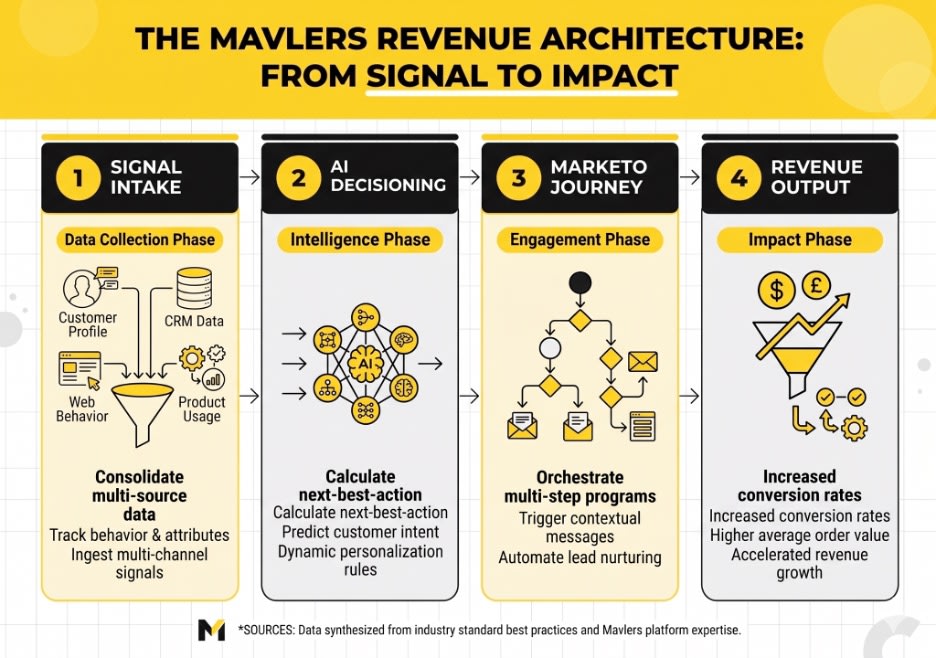
A specialized Marketo marketing agency closes it by turning Marketo from a campaign tool into a revenue system. Not more noise. But more orchestration. More precision. More lift.
Let’s cut to the chase.
Table of Contents
- What separates basic automation from an agentic Marketo strategy?
- How does a Marketo agency drive B2B lifecycle conversions?
- How can you prove ROI with a 4-layer B2B attribution model?
- Why does a Marketo-first agency matter more than ever?
- Wrapping up
What separates basic automation from an agentic Marketo strategy?
While basic automation relies on rigid if-then rules that demand constant human oversight, an advanced Marketo strategy uses agentic AI to orchestrate journeys, analyze intent, and adapt messaging in real time.
The shift is already underway. The old model was simple: trigger, wait, send, hope. The new model is less obedient and far more useful.
By 2026, task-specific AI agents will sit quietly within enterprise workflows. They will assemble campaigns, monitor signals, recommend next actions, and learn from outcomes. That changes the job of marketing from production to strategy.
And the numbers are moving in that direction.
- 94% percent of B2B marketers report revenue gains from AI.
- 61% percent of B2B teams already use AI to flag conversion-ready leads.
The catch is obvious. AI is only helpful when it is not allowed to wander. A sharp Marketo agency implements the pieces that move lead quality, and leaves the shiny distractions in the lobby.
How does a Marketo agency drive B2B lifecycle conversions?
A specialized agency turns Marketo into a high-converting revenue engine by ensuring CRM synchronization, deploying predictive lead scoring, and orchestrating dynamic, cross-channel B2B journeys.
1. Deep CRM-MA synchronization
B2B campaigns fall apart when data lives in silos. Marketo can be powerful, but only if it sees the same truth as Salesforce.
A specialized agency makes that integration bidirectional and disciplined. Every click, form fill, email action, and lifecycle update needs to connect back to the right account record.
That is not a technical luxury. It is the difference between marketing that reports activity and marketing that informs sales.
2. Predictive lead scoring and routing
Static scoring is tidy. Predictive scoring is useful.
Instead of relying on fixed point models, agencies combine explicit data like job title and company size with implicit behavior like content consumption, email engagement, and repeat visits. That creates a live view of buying readiness.
Sales gets better leads. Marketing gets better feedback. And the score becomes a signal, not a superstition.
3. Dynamic nurture orchestration
Long nurture programs do not succeed because they are long. They succeed because they respond.
This is where Marketo Journey Agent becomes useful. The agency uses it to shape and optimize ABM and nurture programs over time, instead of setting a path and praying the buyer behaves.
A flow should not feel like a calendar. It should feel like a conversation that knows where the customer is standing.
4. Integrating external AI via webhooks
This is where the serious technical edge comes into play.
Top agencies use webhooks and REST APIs to connect Marketo with external AI platforms, including OpenAI or custom classifiers. That opens the door to real-time enrichment, smarter segmentation, and classification logic that is much deeper than a tag or checkbox.
- A lead can be scored.
- A record can be enriched.
- A segment can evolve before the next send.
That is not just automation. That is motion with memory.
| Capability | Basic team | Strategic agency |
|---|---|---|
| CRM sync | Functional | Bidirectional and governed |
| Scoring | Static | Predictive and adaptive |
| Nurture | Linear | Journey-based |
| AI usage | Experimental | Operational |
| Reporting | Rearview | Revenue-linked |
How can you prove ROI with a 4-layer B2B attribution model?
To measure Marketo’s impact on long B2B sales cycles, top agencies use a 4-layer attribution model that connects early engagement to closed-won revenue across Discovery, Engagement, Acceleration, and Expansion.
B2B attribution is not a one-week conversation. It is a long walk through the buyer’s committee, internal approvals, and the kind of delay that makes everyone question their life choices.
That is why the tracking window matters.
If you only measure the final touch, you erase the work that made the opportunity possible.
If you only measure first touch, you turn complex buying into a postcard.
The answer is a structured, layered model.
One that assigns credit across the full path without pretending every stage matters the same way.
| Attribution Layer | Stage of the Buying Process | Examples | Attribution Model |
|---|---|---|---|
| Discovery | Initial awareness | Ad, blog post, webinar | First-touch attribution |
| Engagement | Mid-funnel value reinforcement | Product demos, nurture emails | Multi-touch or weighted |
| Acceleration | Late-stage decision support | ROI calculators, sales outreach | Last-touch or time-decay |
| Expansion | Post-sale revenue growth | Upsell emails, feature announcements | Full-funnel or custom |
That structure does two things. It gives leadership a dashboard that speaks business. And it gives marketing the proof it has earned the right to ask for more budget.
The best agencies build live dashboards that blend engagement data with opportunity creation and closed-won revenue.
Not because dashboards are pretty. Because revenue is less emotional when it is visible.
If the report cannot explain the next budget decision, it is decoration.
Why does a Marketo-first agency matter more than ever?
Because the platform is not the problem. The misuse is.
Marketo Engage is designed to support complexity. But complexity without strategy becomes clutter with a login.
A strong agency brings the discipline to connect CRM sync, journey logic, AI agents, and attribution into one operating system. That is where the leverage lives. Not in adding more campaigns. In making the existing machine smarter.
The difference is subtle on paper and enormous in practice. One team sends. The other engineers movement.
Wrapping up
That brings us to the business end of this article, where it’s fair to say that
Marketo is a sophisticated B2B engine. Left alone, it will do what many platforms do: a lot, inconsistently.
A strategic agency changes that. It connects the data, sharpens the signals, and builds the kind of orchestration that turns automation into revenue.
If your Marketo instance is running but not compounding, the architecture needs work.
The ball is in your yard now. It’s time to make every effort count.
Want to publish a guest post on aamax.co?
Place an order for a guest post or link insertion today.
Place an Order