

What Is a Data Integration Platform?
Data integration is the blood, bone, and skin of all modern businesses. To operate efficiently, they need to understand the market, their customers, their capacities, as well as the risks and opportunities they might face, and real time data integration is what helps them make sense of this information.
The problem is that data keeps flowing from too many directions at once. Social media platforms, personal websites, financial reports, and predictive analytics centers: each of these systems is bursting with tons of valuable info.
How to accumulate it in one place to facilitate analysis and refine future marketing and product development strategies? There is only one answer here: data integration platforms.
The Concept of a Data Integration Platform
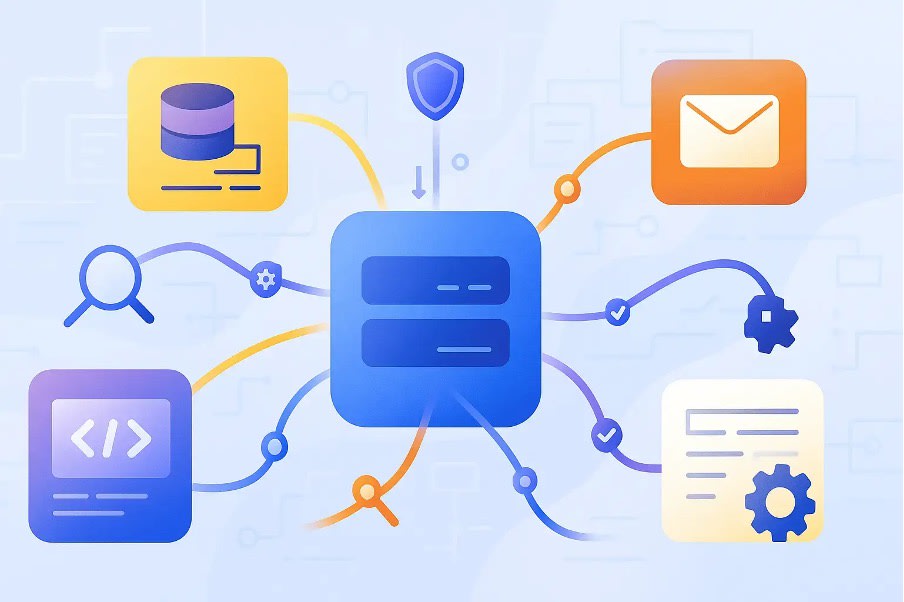
A data integration platform is a software solution that connects multiple data sources into one well-organized system. Businesses constantly need information from their databases, cloud services, applications, marketing tools, etc., and without a centralized platform, processing everything would be a nightmare. How do they go about acquiring such a system, though?
Some businesses prefer to build their own data integration platforms. This lets them maintain full control and customize everything according to their unique demands; however, this approach requires a lot of time and an experienced technical team.
Others prefer to hire external developers to create a data integration platform for them. This can be useful, but this approach is extremely expensive, so most startups can’t afford it.
A lot of companies prefer to rely on third-party software vendors. This is cheaper and more cost-efficient, but newbies might struggle to understand technical set-ups and organize all the integrations properly.
For newer or smaller companies, the third approach is the most efficient because it requires no time and minimal upfront investments. While all the complex set-ups might seem intimidating to non-technical users, the existence of a Coupler.io no-code integration platform has successfully solved this problem for modern companies. A no-code interface means that the staff can figure out what to do quickly, facing no need to write scripts or manage servers.
In addition, external vendors offer simple scalability. You won’t have to rebuild your pipelines in case you need to increase your number of operations; the system will be flexible, so you’ll be able to focus on your core business functions.
Why Businesses Need Enterprise and Cloud Data Integration Tools
Most businesses choose to use enterprise systems and cloud tools together to achieve the maximum level of efficiency. Let’s see why and how these tools can help.
Centralization
Enterprise data integration tools help consolidate information from multiple departments and CRMs. The key is in the name: these tools can handle large volumes of data, but you don’t need to have an enterprise-level business to use them. Whether your company is big or small, you can use enterprise integration tools to automatically combine tons of info in one coherent dataset.
Cloud integration tools, in turn, centralize this data in cloud data lakes. It means that you can get flexible systems updated in real time.
Data Management
The spending on data management is expected to reach 513.3 billion dollars by 2030. It’s one of the core aspects of every business, and both enterprise and cloud integration tools are essential in keeping it efficient.
Such tools provide thorough data encryption and role-based access control, meaning that only specific employees get to work with specific blocks of information.
These tools enforce the same data quality rules and maintain audit trails for financial records; they help ensure compliance with GDPR and HIPAA.
Since scalability is automatic, these tools can easily handle wildly fluctuating workloads without requiring complex infrastructure.
Basically, enterprise tools are ideal for governance and compliance, while cloud integrations are ideal for scalability and automation.
Synchronization
Enterprise data integration tools help keep internal business systems aligned. Let’s say the contact details of some of your customers changed in the CRM; proper integration will ensure that the corresponding updates take place across billing and logistics systems, too.
Cloud data integration guarantees hybrid connectivity and real-time synchronization. After all, the cloud detects changes immediately, so it updates all the systems right away: a new lead in HubSpot will automatically appear in your Google Sheets and Slack.
Modern ETL Platforms: Features and Benefits
The ETL platform is one of the most common types of integration technology. Modern no-code ETL solutions such as Coupler.io make it possible to build automated data pipelines without extensive engineering resources. The “ETL” stands for “Extract, Transform, Load,” and the system itself can automate the movement and preparation of data.
Here are the key features of ETL data integration tools:
Data pipeline automation. There is no need to transfer files manually: pipelines move them automatically, detecting changes and introducing immediate updates.
Real-time data integration. ETL platforms can process real-time data streams, delivering useful insights while the moment is still hot.
Cloud-native architecture. ETL tools are fully optimized for hybrid as well as multi-cloud deployments, so you can grow at any scale without worrying about hitting a roadblock.
Strong security measures. ETL-based integration tools come with strong security: they provide thorough data encryption and role-based access, which keeps the company’s sensitive info safe.
These features bring a lot of benefits to businesses, including improved analytics and faster decision-making. In turn, this leads to enhanced operational efficiency: companies get a clearer understanding of what their customers want, so they can work on deepening their competitive advantage and provide even better client experiences.
Want to publish a guest post on aamax.co?
Place an order for a guest post or link insertion today.
Place an Order