

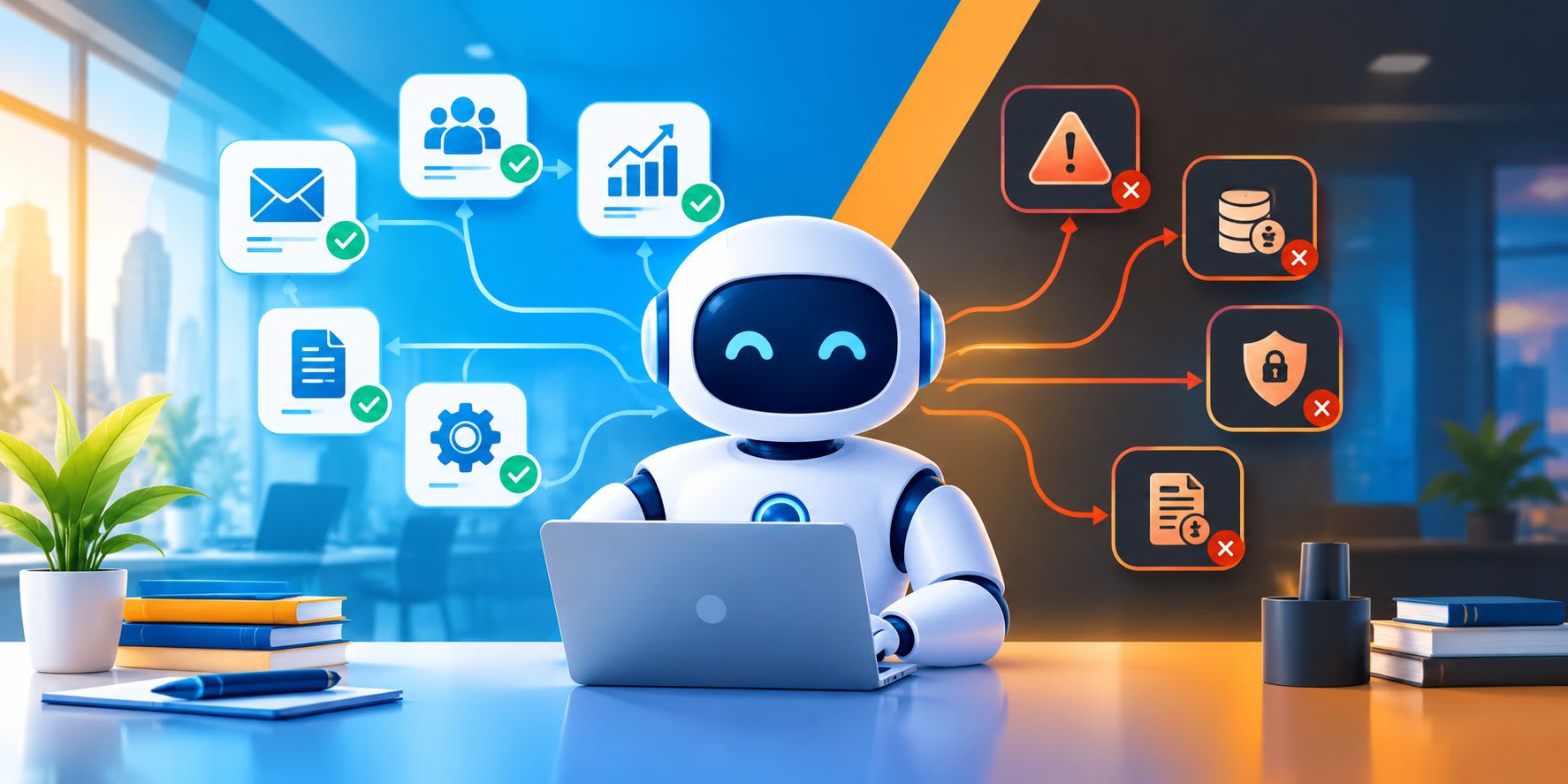
Agentic AI for Business Automation: Where to Start and What to Avoid
A practical guide to use cases, organizational readiness, vendor selection and moving pilots into production
AI agents are moving from demos into real business workflows, but the gap between a compelling prototype and a dependable production system is still wide. The strongest implementations do not begin with the question, “Where can we add an agent?” They begin with a business process that is slow, repetitive, fragmented or hard to scale, then ask whether an agent is the right operating model for improving it.
That distinction matters. Agentic systems can plan, choose tools, call APIs, retrieve information and take actions across multiple steps. Those capabilities can remove manual handoffs, but they can also create new risks when permissions, data quality and accountability are unclear. For companies exploring this area in 2026, the goal should be disciplined automation rather than automation for its own sake.
Start With the Workflow, Not the Technology
The best starting point is a workflow where people already follow a repeatable sequence of decisions and actions. If the process is vague, political or dependent on deep judgment, an agent may only automate confusion. If the process is measurable and bounded, the opportunity is much clearer.
Good early candidates often share three traits:
- The work has several steps, not just one prompt-and-response interaction.
- The inputs and outputs are digital and can be accessed through approved systems or APIs.
- A human can quickly verify the result when the agent is uncertain or when the action carries risk.
Teams comparing practical use cases can review examples of AI agents for automation to see how different tools approach operational tasks. The comparison is most useful when it helps a company map product capabilities to a specific workflow rather than simply choosing the most feature-rich platform.
High-value use cases tend to be narrow at first
An agent that handles one well-defined slice of a process is usually easier to govern than an agent expected to run an entire department. A customer support agent might classify requests, retrieve account context and draft a response before escalation. A finance agent might reconcile known transaction types and flag exceptions. A sales operations agent could prepare account research, update records and suggest next actions while leaving pricing and contract decisions to people.
These narrow implementations create a useful learning loop. They expose integration gaps, permission issues and failure patterns before the company entrusts the system with broader authority.
Get the Organization Ready Before Giving an Agent Access
Agentic AI is not only a software project. It is an operating-model change because the system may act on company data and applications rather than merely generate text. Readiness therefore depends on process ownership, data hygiene, security and decision rights.
A useful readiness review should cover governance, data access, workforce roles and executive sponsorship; guidance on agentic AI readiness can help leadership teams frame those questions before a pilot expands beyond a small group.
Four readiness questions to answer
Who owns the process? One business owner should be accountable for the outcome, even when several technical teams support the system.
What can the agent see? Access should be limited to the minimum data and tools needed for the assigned task.
What can the agent do without approval? Read-only actions, drafts and reversible changes can usually be automated more safely than payments, deletions, refunds or contract decisions.
How will failures be detected? Define logs, alerts, sampling and human review before launch, not after the first incident.
A simple way to classify agent actions
Action type | Example | Default control |
Low risk | Summarize a support case | Automatic with logging |
Moderate risk | Update CRM fields | Automatic only within rules |
High risk | Issue a refund or change pricing | Human approval required |
Critical | Delete records, move money, alter legal terms | Usually keep outside autonomous scope |
Design the Agent Around Boundaries
A production agent needs more than a model. It needs instructions, tools, data connections, memory rules, permission boundaries, fallback logic and observability. The architecture should make it easy to answer a basic question after any action: what did the agent know, what did it decide, which tool did it use and why?
A common mistake is giving an agent broad application credentials because it makes the pilot faster. That shortcut creates hidden risk. Service accounts should be scoped. Sensitive actions should use separate approval paths. Tool calls should validate inputs. External content should never be treated as trusted instructions by default.
Keep humans where judgment is expensive to get wrong
Human review is not a failure of automation. It is a design choice. In many workflows, the best system automates preparation and execution while reserving judgment for unusual or consequential cases. The handoff should be explicit: the agent should provide context, explain what it attempted and surface the exact point where a person needs to decide.
Even in case of agentic AI in financial services, you can restrict the use of AI agent to keep the human judgment expensive
Evaluate Vendors on Operations, Not Demo Quality
Agentic products can look similar in a short demo. The differences become clearer when a company evaluates reliability, integration depth, governance and maintainability. Procurement should therefore test vendors against real internal workflows rather than generic benchmark tasks.
Market scans of agentic AI companies can help teams build an initial shortlist, but the final decision should depend on how well each vendor fits the company’s data, security model, systems and operational requirements.
Questions worth asking every vendor
- How are permissions enforced for each tool or connected system?
- Can every action be logged and replayed for investigation?
- How does the platform handle model changes, prompt changes and versioning?
- What happens when a tool call fails halfway through a workflow?
- Can the system require approval for selected actions without breaking the workflow?
- How portable are prompts, workflows, data and evaluation sets if the company changes vendors later?
The strongest answer is rarely “our model is smarter.” In production, reliability often depends more on workflow design, tool quality, error handling and monitoring than on small differences in raw model capability.
Move From Pilot to Production Deliberately
Pilots are usually forgiving. A small group knows the system is experimental, watches it closely and compensates for errors. Production removes that safety net. More users, more data, more integrations and more edge cases arrive at once.
A structured roadmap for moving an AI pilot to production is useful because scaling requires engineering discipline, governance and adoption work in addition to a successful proof of concept.
Define success before scaling
A pilot should have operational metrics tied to the original business problem. Useful measures include cycle time, completion rate, manual touches per case, error rate, escalation rate, cost per task and user satisfaction. Model accuracy by itself is rarely enough.
For example, an agent that drafts customer responses may look accurate in testing but still fail the business objective if employees rewrite every answer. In that case, acceptance rate and editing time are better measures than whether the draft sounds reasonable.
Use staged autonomy
A practical rollout often follows a sequence: observe, recommend, act with approval, then act automatically within defined limits. The agent can first watch a workflow and propose actions. Once its behavior is understood, selected actions can move behind one-click approval. Only stable, reversible and well-monitored actions should become fully autonomous.
What to Avoid
Automating a broken process: If teams cannot agree on the current process, the agent will inherit contradictory rules. Simplify the workflow first.
Treating the model as the security boundary: The agent may be persuaded or confused. Real controls must sit in permissions, APIs and policy enforcement.
Giving the agent unlimited context: More data is not automatically better. Excess context raises cost, slows execution and can expose information the workflow does not need.
Skipping evaluation because the demo looks good: Build test cases from real scenarios, including failures, ambiguous requests and malicious inputs.
Scaling before ownership is clear: Every production workflow needs a business owner, a technical owner and an incident path.
Assuming autonomous means unattended forever: Workflows, models and connected systems change. Continuous evaluation is part of operating the system.
A Practical 90-Day Starting Plan
Weeks 1-2: Select one workflow — Choose a process with measurable pain, digital inputs and a clear owner. Document the current baseline.
Weeks 3-4: Define the control model — List tools, data, permissions, prohibited actions, approval points and logging requirements.
Weeks 5-7: Build a constrained pilot — Use real but limited cases. Start with recommendation mode or human approval.
Weeks 8-10: Evaluate failure modes — Test edge cases, tool outages, missing data, conflicting instructions and unauthorized requests.
Weeks 11-12: Decide whether to scale — Compare results with the baseline. Expand only if the system improves the business metric without creating unacceptable operational risk.
The Real Advantage Is Operational Discipline
Agentic AI can give businesses a new way to automate work that previously required people to coordinate across several systems. The technology is most valuable when it reduces friction in a well-understood process, not when it is deployed as a broad experiment with unclear ownership.
Companies that succeed will treat agents as operational systems: scoped permissions, measurable outcomes, staged autonomy, strong evaluation and clear human accountability. Starting smaller may feel less ambitious, but it produces the evidence and control needed to scale safely. In 2026, that is a stronger competitive position than simply having the most agents in production.
Want to publish a guest post on aamax.co?
Place an order for a guest post or link insertion today.
Place an Order