

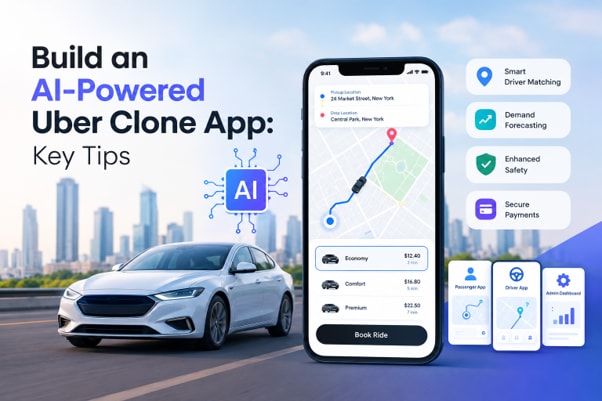
Build an AI-Powered Uber Clone App: Key Tips for 2027
The ride-hailing industry is changing as customers expect faster pickups, transparent pricing, safer journeys, and convenient digital payments. For entrepreneurs planning to enter this market in 2027, artificial intelligence (AI) offers new ways to manage drivers, predict demand, improve route planning, and deliver better passenger experiences.
However, launching a successful taxi business requires more than developing an app with an attractive interface. You need a reliable booking system, a strong driver network, efficient dispatch operations, and technology that can grow alongside your business.
Building an AI-powered Uber clone app can help bring these elements together. With the right features and business strategy, you can launch your own ride-hailing platform, serve a specific market, and compete with established transportation services.
Why Build an AI-Powered Uber Clone App in 2027?
Customer expectations are rising, and traditional taxi operations can struggle with manual bookings, inefficient dispatching, and unpredictable driver availability. AI-powered ride-hailing applications can help address these challenges by analyzing trip data, automating repetitive tasks, and supporting faster operational decisions.
According to Statista's ride-hailing market forecast, global ride-hailing revenue is projected to reach approximately $188.6 billion in 2026. This market outlook highlights the scale of the opportunity for businesses offering convenient, app-based transportation.
For startups and established taxi operators, the goal should not be to copy every feature of Uber. Instead, build a platform that addresses local transportation needs, offers a reliable booking experience, and uses AI where it can deliver measurable business value.
1. Identify Your Target Market Before Development
Before investing in development, determine who will use your service and what problems your platform will solve. A taxi app designed for a metropolitan city may require different features from one serving smaller towns, tourist destinations, or corporate customers.
Start by researching your intended market and evaluating existing ride-hailing services. Look for gaps in pricing, availability, safety, booking convenience, and customer support.
Consider the following business opportunities:
- Local taxi services: Offer convenient transportation within a defined service area.
- Airport transfers: Support scheduled pickups, flight-related updates, and advance bookings.
- Corporate transportation: Provide employee rides, business accounts, and centralized billing.
- Bike and two-wheeler rides: Serve customers who prefer affordable options for shorter trips.
- Premium rides: Target customers looking for executive vehicles and professional drivers.
Choose a business model that matches local demand and your available resources. Starting with a focused service area can make it easier to test your concept before expanding into additional locations.
2. Choose the Right Development Approach
One of the most important decisions is whether to build the platform from scratch or use a readymade solution.
Custom development gives you greater control over the application architecture, features, and integrations. However, it may require a larger initial investment, more development time, and ongoing technical resources.
If you want to build an Uber clone app on a limited budget, choosing a readymade solution can help you launch faster without developing every feature from scratch. An Uber app clone solution provides a foundation for creating your own ride-hailing platform with essential features such as real-time GPS tracking, smart driver matching, secure payments, and an admin dashboard.
Before selecting a solution, check whether it supports your business requirements, including passenger and driver apps, an admin dashboard, payment integrations, customization, and future AI enhancements.
Also, review the licensing terms, source-code access, scalability, maintenance arrangements, and any recurring fees. A lower initial price is useful only if the platform can support your business as it grows.
3. Integrate AI-Powered Driver Matching
Driver matching is one of the most valuable areas for AI in a ride-hailing application. Traditional systems may assign rides primarily according to the nearest available driver. An AI-powered system can consider several additional factors when recommending a suitable driver.
These factors may include:
- Driver location and estimated arrival time.
- Current traffic conditions and road closures.
- Driver availability and ongoing trip status.
- Vehicle category and passenger preferences.
- Historical demand and pickup patterns.
For example, when a customer requests a ride during rush hour, the system can evaluate nearby drivers and recommend the option that is most likely to reach the pickup location efficiently.
The objective is to reduce unnecessary waiting, limit avoidable driving, and distribute ride requests more effectively.
Keep a human-review or manual-dispatch option available for unusual situations. AI recommendations should support operational decisions rather than make the system dependent on a single prediction.
4. Use Predictive Analytics to Forecast Demand
Ride demand changes according to location, weather, local events, working hours, holidays, and commuting patterns. Without reliable forecasting, businesses may have too many drivers in low-demand areas and too few where customers need rides.
Predictive analytics can use historical booking records and relevant real-time information to estimate when and where demand is likely to increase.
Your app can use these insights to:
- Identify busy pickup locations.
- Recommend areas where drivers may find more requests.
- Plan staffing during peak hours.
- Anticipate demand around airports, business districts, and event venues.
- Support decisions about expanding into new service areas.
For example, if past data indicates a recurring increase in bookings near an office district between 5 p.m. and 7 p.m., the platform can notify drivers about the expected demand.
Predictions will not always be accurate, especially when unexpected events occur. Monitor forecast performance and update models as new data becomes available.
5. Implement Smart Pricing With Clear Fare Estimates
Pricing directly affects customer decisions and business profitability. Passengers want affordable rides, while drivers need fair compensation and operators must cover their expenses.
AI-assisted pricing can analyze demand, available drivers, traffic conditions, trip distance, and estimated travel time to help calculate suitable fares.
However, dynamic pricing should be transparent and carefully controlled. Unexpected fare increases can damage customer trust, particularly during emergencies or periods of limited transportation availability.
Build a pricing system that includes:
- Upfront fare estimates before booking.
- Clear breakdowns of base fares, distance, time, and additional charges.
- Configurable minimum and maximum pricing limits.
- Notifications when fares change.
- Monitoring for unusual or potentially unfair price variations.
Your pricing strategy should reflect local regulations and customer expectations. AI can help inform pricing decisions, but the final rules should remain understandable to passengers and drivers.
6. Prioritize Passenger and Driver Safety
Safety should be a core part of your application rather than an optional feature added after launch. Passengers need confidence in their drivers, and drivers need tools to manage difficult or unsafe situations.
Include practical safety features such as:
- Real-time GPS tracking and trip sharing.
- SOS or emergency assistance buttons.
- Emergency contact configuration.
- Driver and passenger identity verification.
- Masked phone numbers to protect personal information.
- Trip history and incident-reporting options.
- Ratings and reviews after completed rides.
AI can also help flag unusual trip patterns or potentially suspicious account activity for further review. These systems should be carefully tested to avoid unfairly flagging legitimate users.
An automated alert should not be treated as proof of wrongdoing. Establish clear procedures for reviewing incidents, protecting personal data, and responding to emergency reports.
7. Build Separate Apps for Passengers, Drivers, and Administrators
A complete Uber-style platform requires multiple connected components. Each serves a different purpose, and all must communicate reliably through a shared backend.
Passenger app
The passenger application should make booking a ride straightforward. Essential features include registration, location selection, fare estimates, ride scheduling, driver tracking, digital payments, trip history, and ratings.
Keep the booking flow simple so users can request a ride without navigating unnecessary screens.
Driver app
Drivers need an interface that helps them manage trips and earnings. Include driver registration, document verification, availability controls, ride requests, navigation, trip status updates, earnings reports, and notifications.
A clear driver interface can reduce confusion and help drivers manage their work more efficiently.
Admin dashboard
The admin panel gives your team control over daily operations. It should support driver approvals, passenger management, fare configuration, trip monitoring, promotions, payment records, complaints, and business reports.
Add AI-assisted insights where appropriate, such as demand forecasts, unusual activity alerts, and performance summaries. Keep sensitive administrative actions protected through role-based permissions and audit logs.
8. Select a Scalable and Secure Technology Stack
Your application's technology foundation affects its performance, reliability, and long-term maintenance costs.
Choose technologies according to the skills of your development team, expected user volume, integration requirements, and budget. The platform should support real-time location updates, booking notifications, payment processing, and reliable data storage.
Important technical considerations include:
- Cloud infrastructure: Scale resources as bookings and active users increase.
- Real-time communication: Keep driver locations and trip statuses updated efficiently.
- Database design: Store user profiles, bookings, transactions, and operational records securely.
- API integrations: Connect mapping services, payment providers, messaging systems, and AI tools.
- Security controls: Use encryption, secure authentication, access permissions, and appropriate data-retention policies.
- Monitoring and backups: Detect service failures and recover important business information.
Avoid adding complex AI infrastructure before you know which features need it. Start with a dependable core platform and introduce additional capabilities as your business requirements become clearer.
9. Improve Customer Retention Through Personalization
Getting customers to install your app is only the first step. Long-term growth depends on providing a consistent experience that encourages people to book again. AI can help personalize selected parts of the passenger journey using appropriate booking and preference data.
For example, your platform might suggest previously used pickup locations, recommend suitable ride categories, or send reminders for scheduled trips. Applying the principles of digital marketing and customer experience can also help you understand passenger expectations and create more engaging experiences. Customer support tools can answer common questions about bookings, payments, and cancellations.
For AI chatbots, provide clear escalation options so users can contact a human representative when a problem requires individual attention. Personalization should be useful rather than intrusive. Explain how personal data is used, collect only what is necessary, and give users appropriate privacy controls.
10. Test the App and Launch in Stages
Launching across multiple cities before validating the platform can create operational problems. A phased rollout gives you time to identify weaknesses and improve the customer experience.
Begin with a pilot launch in one service area. Recruit a manageable number of drivers, test the booking process, verify payment handling, and gather feedback from real users.
Before expanding, test:
- Registration and identity verification.
- Driver matching and location accuracy.
- Fare calculations and payment failures.
- Cancellation and refund workflows.
- SOS and emergency-contact functionality.
- Peak-time performance and network interruptions.
- AI predictions, recommendations, and fallback behavior.
Track metrics such as completed trips, pickup times, cancellations, repeat bookings, driver retention, and customer complaints. Use the results to decide which improvements should be prioritized.
A staged launch also helps you control costs while building a stronger operational foundation.
Final Thoughts
Building an AI-powered Uber clone app for 2027 requires a balance between useful innovation and dependable ride-hailing fundamentals. Smart dispatching, demand forecasting, transparent pricing, strong safety features, and personalized customer experiences can help your business stand out in a competitive market.
You do not need to introduce every advanced feature on day one. Start with a reliable passenger app, driver app, admin dashboard, and secure booking infrastructure. Then add AI capabilities that solve specific problems and demonstrate measurable value.
Choose your development approach carefully, validate the platform in a focused market, and use real operational data to guide future improvements. With a clear business model and a scalable technology strategy, you can build a ride-hailing service that is ready to grow in 2027 and beyond.
Want to publish a guest post on aamax.co?
Place an order for a guest post or link insertion today.
Place an Order