

Custom Website Development in the Age of AI | UK Guide
Custom Website Development in the Age of AI: When Do Businesses Still Need Developers?
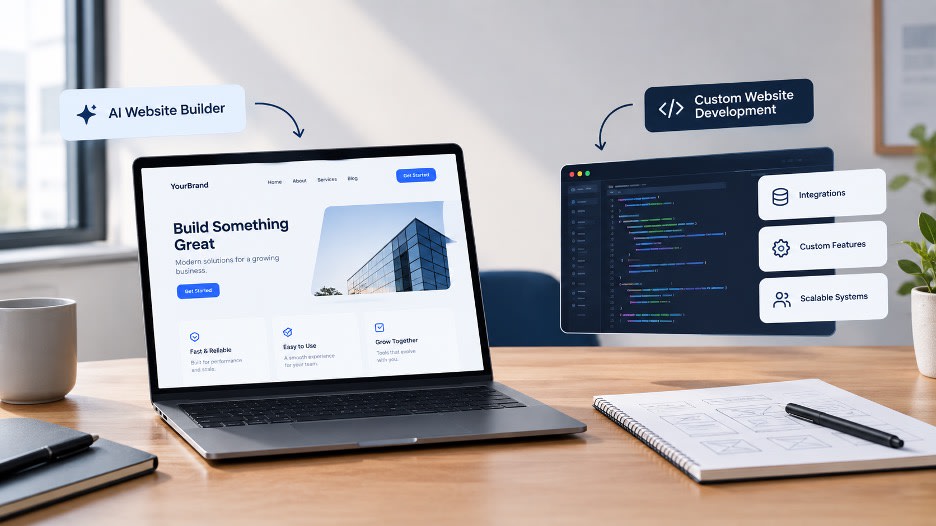
An AI website builder can now produce a working homepage in minutes. Give it a business name and a rough description, and it will generate layout, copy, and often working code behind it. So it's a fair question to ask: why would a business still pay for custom website development services?
The honest answer isn't that AI can't build a website. It clearly can. The real question is whether the site you need is simply a set of pages, or whether it needs to actually run part of your business. Those are two different jobs, and AI has only really solved one of them.
What's actually changed
AI website builders and coding agents have moved well past generating a single homepage. Many can now put together a working site with forms, basic databases, and simple logins attached, not just a static page with a contact box. That's a genuine shift, and it's worth acknowledging rather than dismissing.
For a straightforward business site, that's good news. It's faster, cheaper, and often good enough. The more useful question isn't whether AI can build a website anymore. It's where that stops being enough.
Where an AI builder is genuinely the right call
Not every business needs a development team, and it would be dishonest to suggest otherwise. A brochure site, a landing page for one campaign, a portfolio, a simple blog, an early prototype to test an idea, these are all reasonable jobs for an AI builder or a good template.
If your requirements stop there, there's little reason to commission a large custom build. That's worth saying plainly, because the businesses that actually need custom website development services usually already sense their situation is different.
Why this decision matters right now
Across the UK, self-reported AI use among businesses with ten or more employees has grown from around 12% to roughly 35% since late 2023, according to the Office for National Statistics. That's real growth. But adoption has stayed shallow. The average AI-using business has only moved from about 1.4 tools to 1.6. Use still varies enormously by sector, from over half of information and communication businesses down to a much smaller share in construction.
The UK government's own thinking on AI adoption points to the same pattern: depth of integration, not headline adoption, is what actually drives results. A business can technically "have AI" and still be running a website that doesn't talk to anything else it owns. That gap is exactly where custom development tends to live.
Where custom development starts to matter
The shift usually happens around a handful of specific triggers:
- The systems your website needs to talk to.
- Functionality that doesn't exist in a template.
- Data your business needs to use safely.
- Security and accessibility once real people are using it.
- The point where a website becomes an application, not just pages.
Here's what each one actually looks like.
The systems that already run the business
Most growing businesses run on more than one system already. A CRM holding customer records. Booking or inventory software. A payment processor. Marketing tools that need fresh data to work properly.
An AI-generated site can look finished and still have no real connection to any of that. Someone ends up checking stock by hand, or copying form submissions into the CRM one at a time. A proper integration, one that pulls live data and pushes it back automatically, is what actually makes a website part of the business instead of something sitting next to it. It's a smaller version of the same integration work that larger, enterprise-level platforms have to solve at scale. That's usually where website integration, not just page generation, starts to matter.
Functionality that doesn't exist in a template
A generic builder is good at pages. It's much weaker at things with no obvious template. A quote calculator using your real pricing logic. A booking system with your specific rules. A customer dashboard. An approval workflow. Search that actually understands your catalogue.
AI tools can generate code for pieces of this. What they can't do is decide what the feature should do for your business, which edge cases matter, or how it should behave when something goes wrong. That's still a design decision, and it's usually where a custom web development company earns its cost.
Using your own data properly, and putting real AI inside the site
There's a difference between a chatbot bolted onto the corner of a page and AI that's actually useful inside a business. Real AI-powered features depend on connecting a model to your own data properly: your catalogue, your policies, your customer history. That covers things like smart search, product recommendations, document handling, and lead qualification.
A generic AI builder has no access to any of that, and it shouldn't guess. Wiring a website up to your own data, safely and correctly, is closer to software engineering than a website feature. This is usually where teams offering both web development services and ai ml development services end up more useful than either one alone. The site and the model behind it need to be built together.
Security and accessibility once real people are involved
The moment a website starts handling logins, payment details, or personal customer data, website security stops being optional. The UK's data protection regulator, the ICO, has detailed guidance covering exactly this: data minimisation, a proper lawful basis for processing, and a formal impact assessment for higher-risk AI processing. None of that happens by accident.
Accessibility works the same way. WCAG 2.2, the current accessibility standard, added new requirements around things like minimum touch target size, keeping focus indicators visible, and not forcing people to re-enter information they've already given you. A page that looks fine to a sighted user with a mouse can still fail these in ways that only show up under proper testing.
Neither of these is something an AI builder checks by default. Both are the kind of detail a person still has to design for on purpose.
The website is becoming an application, not a collection of pages
There's a useful test here. A website has pages, content, and maybe a contact form. An application has accounts, a database, workflows, and business logic behind the screen.
Once a site starts behaving like the second one, the real decision isn't AI builder versus website builder anymore. It's a software decision. That's usually the point businesses start looking at web application development, or custom web application development specifically, rather than another website project.
What developers actually do differently now
None of this means AI has made developers less useful. It's changed what the job looks like day to day.
The old version of the job was writing most of the code by hand. The current version of the job looks different. It's deciding what should be built and why. Directing AI tools to generate a first pass. Reviewing and correcting what comes back. Testing it properly. Connecting it to the systems it needs to talk to. Handling website maintenance as the business changes. Keeping the whole thing secure.
AI has probably reduced how much code a developer types manually. It hasn't reduced how much judgement a working system needs. That's the part a template, or a well-written prompt, still can't supply on its own. It's also why a documented web development process still matters, even when part of the build is AI-assisted.
AI builder vs. custom development, by requirement
| Requirement | AI website builder | Custom development |
|---|---|---|
| Simple marketing site | Usually enough | Often unnecessary |
| Landing page or campaign site | Usually enough | Often unnecessary |
| System integrations (CRM, payments, bookings) | Limited | Better suited |
| Custom functionality (calculators, portals) | Limited | Better suited |
| Real AI features using your own data | Limited | Better suited |
| Strict security or compliance needs | Depends | Better suited |
| Site becoming a customer-facing application | Limited | Better suited |
When you probably don't need custom development
It's worth saying this clearly, because it's easy for an article like this to sound one-sided. If your website is a simple brochure site, a landing page, a portfolio, or a basic informational site, custom development is usually more than you need. An AI builder or a solid template will do the job well, and cheaply.
The economics change once a website needs to connect systems, handle real workflows, use your own data, or become part of how customers actually interact with the business. At that point, website development cost is better thought of as a comparison, not a fixed number, weighed against what a broken integration or a security gap costs later.
Questions worth asking before you decide
A few honest questions, the kind a good web development consultant would ask first, usually settle this:
- Is the site mainly informational, or does it need to do things?
- Does it need to connect to systems you already use?
- Will users have accounts, logins, or personalised dashboards?
- Will AI need access to your own data to be useful?
- Will requirements keep changing over the next few years?
If most answers point toward "yes, and it matters," that's usually a sign the project needs proper engineering, not just generation.
The real value of a development partner
This is where a good provider earns its fee. Not by writing code faster than AI can. It's by turning business requirements into something that actually holds up once it's live, following web development best practices around security, accessibility, and structure rather than skipping them under time pressure.
Bytes Technolab is one example of a custom web development company that works this way. It treats website design and development, system integrations, and the AI or data work behind a site as one connected project, rather than separate add-ons. That approach tends to matter most for businesses whose site has already outgrown a template. That usually shows up as a growing list of manual workarounds, or a site that's simply becoming harder to maintain.
The bottom line
Choosing between an AI builder and custom development isn't really about which one produces a website faster. It's about what that website actually needs to do. If the answer involves your own systems, your own data, real security, or a genuine application rather than a set of pages, that's your answer. That's usually the moment a website stops being something you generate and starts being something you engineer.
FAQ: custom website development in the AI era
Can AI really replace a web developer? For a simple site, often yes. For anything involving integrations, your own data, real AI features, or strict security, AI can help build it, but someone still needs to design, direct, and check the result.
How do I know if I need custom development instead of a builder? Look at the questions above. If your site needs to connect systems, handle logins, or use your own data safely, a template usually can't do that properly on its own.
Is custom website development always more expensive than an AI builder? Upfront, yes. But it has to be weighed against what a broken integration, a security gap, or a rebuild in a year actually costs. For anything business-critical, the cheaper option upfront isn't always cheaper overall.
Can an AI-built website be upgraded later, or does it need rebuilding? It depends how it was built. Some AI-generated sites can be extended. Others were never structured for it, and bolting on real integrations or security afterward often costs more than starting with a proper foundation.
Want to publish a guest post on aamax.co?
Place an order for a guest post or link insertion today.
Place an Order