

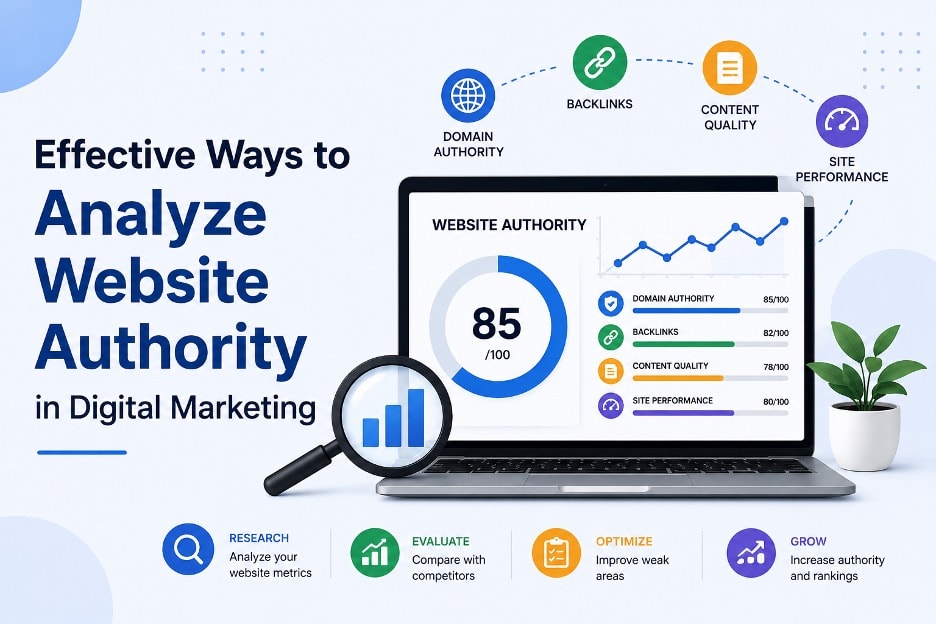
Effective Ways to Analyze Website Authority in Digital Marketing
Suppose two websites are competing for the same keyword. One ranks on the first page. The other is nowhere to be found. The content quality is similar.
So what is the difference?
In most cases, it comes down to website authority.
Website authority is a way of quantifying how powerful and trustworthy a website is in the eyes of search engines. New digital marketers know authority matters. But they do not know how to properly analyze it. They check one metric and make decisions based on incomplete information.
In this blog, we will look at effective ways to analyze website authority so you can make smarter decisions in your digital marketing strategy.
What Is Website Authority and Why Does It Matter in Digital Marketing
Website authority is a measure of how trustworthy and credible a website appears based on factors such as backlinks, content quality, and overall online presence.
Different third-party SEO tools give it names according to their evaluation techniques. This score is not created by Google, nor does Google use it directly to rank sites. It is measured on a scale of 0 to 100. Moz calls it Domain Authority. Ahrefs calls it Domain Rating. SEMrush calls it Authority Score. But they all measure the same basic thing using different methodologies: How trustworthy and credible a website is based on its backlink profile and overall online presence. Websites with higher authority are considered more valuable as backlink sources. A single backlink from a DA 70 website can do more for your rankings than 50 backlinks from DA 10 websites.
How to Analyze a Website's Authority?
Analyzing a website's authority doesn’t only involve using a domain authority checking tool; paying attention to several other aspects also helps you evaluate authority more accurately. Let's discuss this in detail:
1) Check the Domain Authority Score
The first step is to check the domain authority score of the website. A score above 50 is generally considered good, while a score above 80 is typically associated with highly authoritative sites.
But the tool you use to check DA should be accurate. Different tools calculate domain authority differently. So using a reliable tool gives you accurate insights.
One good option is DA PA Checker. You can check the domain authority of any website by simply entering the URL. The tool shows you the DA score, PA score, and other key metrics in seconds. It also allows you to check multiple URLs at once, which saves a lot of time when you are analyzing multiple competitor websites.
2) Review the Backlink Profile
A high DA score doesn’t always mean that a website has real authority. Some sites enhance their authority score by creating a ton of low-quality or spammy backlinks. Hence, you need to check the backlink profile before trusting the DA score only. You can check this using SEO tools like Semrush.
The first thing that you need to check when assessing a backlink profile is whether the backlinks are coming from unique domains. A site with 500 backlinks from 500 different domains is way more authoritative than a site with 500 backlinks from the same 5 domains. More unique referring domains mean more websites are actually endorsing that site.
The second thing to look at is the quality of those backlinks. Spammy backlinks from irrelevant or poor quality sites are a red flag. It usually indicates that the website has artificially increased its authority score by using black-hat link-building techniques.
3) Review Sources of Traffic & Stability over Time
A really authoritative site will get a steady stream of organic traffic from the search engines. So, if a website has a high authority score but very little organic search traffic, it may be worth investigating further to understand the discrepancy.
Second, check that the traffic is stable over time. Go to your website’s traffic history in a tool like SEMrush or SimilarWeb. A stable or upward trending traffic graph suggests that the website has maintained its authority over time. But if the traffic has sudden spikes and then sharp drops, it could be a big red flag.
4) Check the Core Web Vitals
These are a series of performance metrics that Google uses to measure the user experience of a website. They measure:
- How fast does the page load
- When it becomes interactive
- How stable the layout is while it loads.
If a website has bad Core Web Vitals scores, it’s a bad user experience. And Google considers that when it ranks pages.
So, Core Web Vitals can indirectly play a role in improving your website’s authority. A really authoritative website isn't only strong in backlinks and DA score. It also gives a fast and smooth experience to its visitors. You can check these metrics using Google’s free PageSpeed Insights tool.
5) Check Keywords and Bounce Rate
When looking at authority, consider the keywords a website is ranking for. A truly authoritative website ranks for keywords directly related to its niche. For example, a digital marketing website should be ranking for keywords such as "SEO strategies," "link building," or "content marketing." If they are ranking for unrelated trending keywords just to get traffic, that's a red flag.
Bounce rate is the percentage of visitors who leave a website after viewing only one page. A high bounce rate means visitors aren't finding what they came for. And when a website is targeting irrelevant keywords, the bounce rate may increase because the content quality doesn’t meet the visitor’s expectations.
Final Words
Analyzing website authority is an important part of a good digital marketing strategy. Websites change over time. A site with a good authority score today can drop significantly after a Google penalty or a loss of backlinks.
So revisit the authority analysis of your competitors and your own website every few months. Track the changes in DA score, backlink profile, and organic traffic together. One metric alone never tells the full story.
And remember, building real authority takes time. Focus on producing quality content, earning genuine backlinks, and improving your site's user experience. These are the things that build authority, which lasts long-term.
Want to publish a guest post on aamax.co?
Place an order for a guest post or link insertion today.
Place an Order