

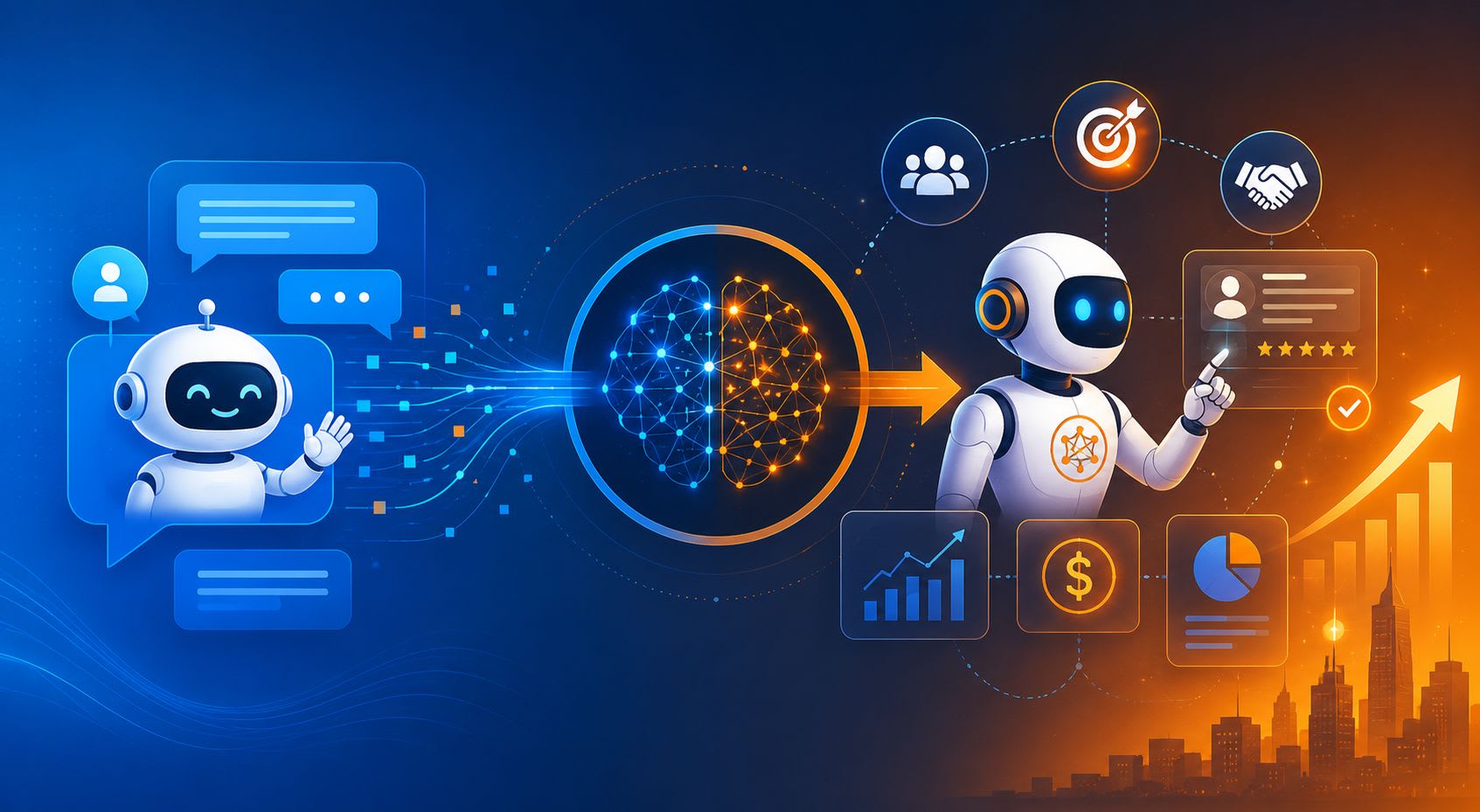
From Chatbots to Cognitive Agents: How Autonomous Reasoning Is Rewriting B2B Sales
For most of the last decade, "sales automation" meant a sequence of triggers. A lead filled out a form, a workflow fired, an email landed in an inbox, and a rep eventually followed up. The logic was rigid, the personalization was shallow, and the moment a prospect did something unexpected, the whole choreography fell apart. Buyers learned to spot the pattern instantly. They could tell when a message had been assembled by a template rather than written by someone who understood their problem.
That era is ending. A new generation of software is moving from rule-following to reasoning, and the shift is reshaping how revenue teams think about pipeline, productivity, and the very definition of a "rep." At the center of this shift sits a deceptively simple idea: instead of telling software exactly what to do at every step, you give it a goal, the context, and the freedom to figure out the path. The result is a class of systems often described as an ai sales assistant — software that doesn't just execute tasks but interprets situations, makes decisions, and adapts in real time.
Why the old playbook stopped working
The traditional sales tech stack was built around the funnel as a conveyor belt. Marketing handed leads to an SDR, the SDR booked meetings, an AE closed them, and customer success picked up afterward. Each handoff was governed by static rules and a CRM that mostly recorded what had already happened rather than helping decide what should happen next.
Three pressures broke that model.
First, buyer behavior changed. Modern B2B purchases involve larger committees, longer cycles, and far more self-directed research before a vendor is ever contacted. By the time a prospect raises a hand, they have often already formed strong opinions. Generic outreach arriving at the wrong moment doesn't just fail to convert — it actively damages the brand.
Second, the volume of signals exploded. Intent data, product usage telemetry, website behavior, social activity, funding announcements, hiring patterns, technographic changes — there is now far more information available about any given account than a human team could ever process manually. The bottleneck is no longer data collection. It is interpretation.
Third, the economics of sales headcount got harder. Hiring, ramping, and retaining skilled reps is expensive and slow, and the cost of a misallocated rep's attention compounds quickly. Companies needed leverage that scaled without linearly scaling salaries.
These pressures created the opening for a fundamentally different architecture — one where software handles interpretation and judgment, not just execution.
What makes an agent "cognitive"
The phrase gets thrown around loosely, so it's worth being precise. Plenty of tools slap "AI" on a rules engine and call it intelligent. The genuinely new capability comes from systems built on large language models that can reason over unstructured context, plan multi-step actions, use external tools, and remember what happened across interactions.
This is the territory of cognitive agents. Rather than executing a fixed branch of if-then logic, a cognitive agent takes a goal — "qualify this inbound lead," "re-engage this stalled opportunity," "research this account before the discovery call" — and decomposes it into the steps required to achieve it. It can read a prospect's last three emails, pull their company's recent press, check the CRM for prior touchpoints, draft a contextual response, and decide whether the situation warrants escalation to a human. Crucially, it can do this without a developer hand-coding every possible path in advance.
A few architectural properties distinguish these systems from earlier automation:
Memory and continuity. The agent retains context across a conversation and across sessions. It knows what was discussed last week and doesn't force the buyer to repeat themselves. This continuity is what makes interactions feel like a relationship rather than a series of disconnected transactions.
Tool use. Modern agents don't live in a sandbox. They call APIs, query databases, update CRM records, schedule meetings, and trigger downstream systems. The reasoning layer decides which tool to use and when, which is closer to how a competent human operates than to a traditional workflow.
Planning and self-correction. When a step fails or a result looks wrong, a well-designed agent can notice the discrepancy and adjust, rather than blindly proceeding down a broken path. This resilience is what separates a demo from a production system.
Goal orientation over instruction-following. You specify outcomes, not procedures. The agent owns the "how." This inverts the entire relationship between operator and software.
Where cognitive agents create real value in the funnel
The most compelling use cases aren't about replacing salespeople wholesale. They're about removing the unglamorous, repetitive cognitive labor that consumes a rep's day and leaves little time for the conversations that actually move deals.
Inbound qualification and instant response
Speed-to-lead remains one of the most reliable predictors of conversion, and yet most teams still respond to inbound interest in hours or days. A cognitive agent can engage a new lead within seconds, ask intelligent qualifying questions, interpret the answers, route high-fit prospects to the right rep, and gracefully nurture the rest. Because it reasons rather than scripts, it handles the messy reality of how people actually phrase things — partial answers, off-topic questions, hesitation — without breaking.
Account research and meeting preparation
Before a discovery call, a strong rep spends thirty to sixty minutes researching the account: the company's priorities, recent news, the prospect's role and likely pain points, competitive context, and how the product maps to their situation. Multiply that across a full calendar and the time cost is enormous. An agent can compile a sharp, structured brief in moments, synthesizing public information with internal CRM history, so the human walks in prepared and spends the meeting listening instead of catching up.
Pipeline hygiene and follow-up
Deals stall not because reps are lazy but because follow-up is tedious and easy to deprioritize. Agents can monitor opportunities, detect when an account has gone quiet, draft contextually appropriate re-engagement messages, and surface the deals most worth a human's attention. The CRM stops being a graveyard of stale records and becomes a living system that nudges the right action at the right time.
Personalization at scale
The old false choice was between personalization and scale: you could write one thoughtful message to one prospect, or one generic message to thousands. Cognitive agents collapse that trade-off. Each message can genuinely reflect the recipient's industry, role, recent activity, and prior conversations, generated fresh rather than mail-merged. The difference in reply rates is not subtle.
The human stays in the loop — by design
A recurring fear is that this technology turns sales into a faceless, automated firehose. In practice, the teams getting the best results treat agents as force multipliers for their people, not replacements. The agent handles research, drafting, qualification, scheduling, and data entry. The human handles trust, negotiation, judgment under ambiguity, and the relationship work that closes complex deals.
This division of labor matters for two reasons. The obvious one is quality: high-stakes B2B decisions still hinge on human credibility. The subtler one is accountability. When an agent operates autonomously, you want clear escalation paths, human review at the right moments, and transparency into why the system made a given decision. Vendors who take this seriously build oversight into the architecture rather than bolting it on afterward.
Companies entering this space reflect that philosophy in their positioning. CogniAgent, for instance, frames its offering around augmenting revenue teams with reasoning-driven automation that keeps a person in control of the outcomes that matter, rather than pursuing automation for its own sake. That framing — leverage with oversight — is increasingly the dividing line between tools that earn long-term adoption and novelties that get switched off after a quarter.
Implementation: where teams succeed and where they stumble
Adopting this technology is less a software purchase than an operational redesign. The organizations that get real returns tend to share a few habits.
They start narrow. Rather than trying to automate the entire revenue motion at once, they pick one painful, well-defined job — inbound qualification, or pre-call research — and prove value there before expanding. A focused win builds the internal trust required for broader rollout.
They invest in data and context. An agent reasons over the information you give it. If the CRM is a mess, the product documentation is scattered, and the ideal-customer profile lives only in someone's head, the agent's output will reflect that chaos. The teams that win clean up their context first.
They define guardrails explicitly. What can the agent send without review? When must it escalate? What tone and claims are off-limits? Treating these as design decisions rather than afterthoughts prevents the embarrassing failures that erode confidence.
They measure honestly. The right metrics aren't vanity counts of messages sent. They're conversion lift, time-to-first-response, rep hours redirected to high-value work, and pipeline velocity. Tying the agent to outcomes keeps the project anchored to business value.
The most common failure mode is treating an autonomous system like a deterministic one — expecting it to behave identically every time and panicking at any variability. Reasoning systems are probabilistic by nature. The discipline is in setting boundaries, monitoring behavior, and iterating, not in chasing the illusion of perfect predictability.
What comes next
The trajectory is clear even if the timeline isn't. As models improve, agents will handle longer and more complex chains of reasoning, coordinate with one another across functions, and take on tasks that today still require human judgment. The boundary between "what the software does" and "what the rep does" will keep moving — and the teams that thrive will be the ones that treat that boundary as something to actively manage rather than something imposed on them.
For now, the practical opportunity is concrete and immediate. Revenue teams drowning in repetitive cognitive work can hand that work to systems built to reason through it, freeing their people to do what people do best. The shift from rigid automation to genuine reasoning isn't a far-off promise. It's already changing the numbers on the dashboards of the teams who moved early — and widening the gap between them and everyone still running the old playbook.
Want to publish a guest post on aamax.co?
Place an order for a guest post or link insertion today.
Place an Order