

How Custom Retail Software Development Helps Businesses Build Smarter, Faster, and More Profitable Operations
Retail has always been a fast-moving industry, but the pace of change today is unlike anything businesses have faced before. Customers expect seamless shopping experiences across online stores, mobile apps, physical locations, marketplaces, social media, and customer support channels. They want personalized recommendations, accurate inventory information, fast delivery, easy returns, secure payments, and consistent service at every touchpoint. For retailers, meeting these expectations requires more than traditional business tools. It requires a connected, scalable, and intelligent software ecosystem built around real operational needs.
This is where custom retail software development becomes a strategic advantage. Instead of forcing a business to adapt to generic platforms, custom software adapts technology to the business model, customer journey, internal workflow, and long-term growth strategy. Whether a company operates a chain of physical stores, an eCommerce marketplace, a direct-to-consumer brand, a wholesale retail operation, or an omnichannel retail network, the right software can transform how teams manage inventory, process orders, understand customers, forecast demand, and increase profitability.
Working with a trusted Retail Software Development Company can help retailers turn complex business challenges into efficient digital solutions. From point-of-sale systems and warehouse management platforms to customer loyalty apps and analytics dashboards, retail software is no longer just a technical investment. It is a foundation for sustainable growth, better decision-making, and stronger customer relationships.
Why Retail Businesses Need Custom Software
Many retailers start with off-the-shelf tools because they are easy to launch and usually require less upfront planning. These tools can be useful in the early stages, especially for small businesses with simple operations. However, as a retail company grows, generic systems often become limiting. They may not support specific workflows, advanced integrations, unique pricing models, complex inventory structures, or personalized customer experiences.
For example, a retailer may use one platform for online sales, another for in-store transactions, a separate tool for warehouse operations, and another system for customer support. At first, this may seem manageable. Over time, however, disconnected systems create data silos, manual work, reporting delays, and operational errors. Employees may have to copy information between platforms, customers may receive incorrect stock updates, and managers may struggle to get a clear picture of business performance.
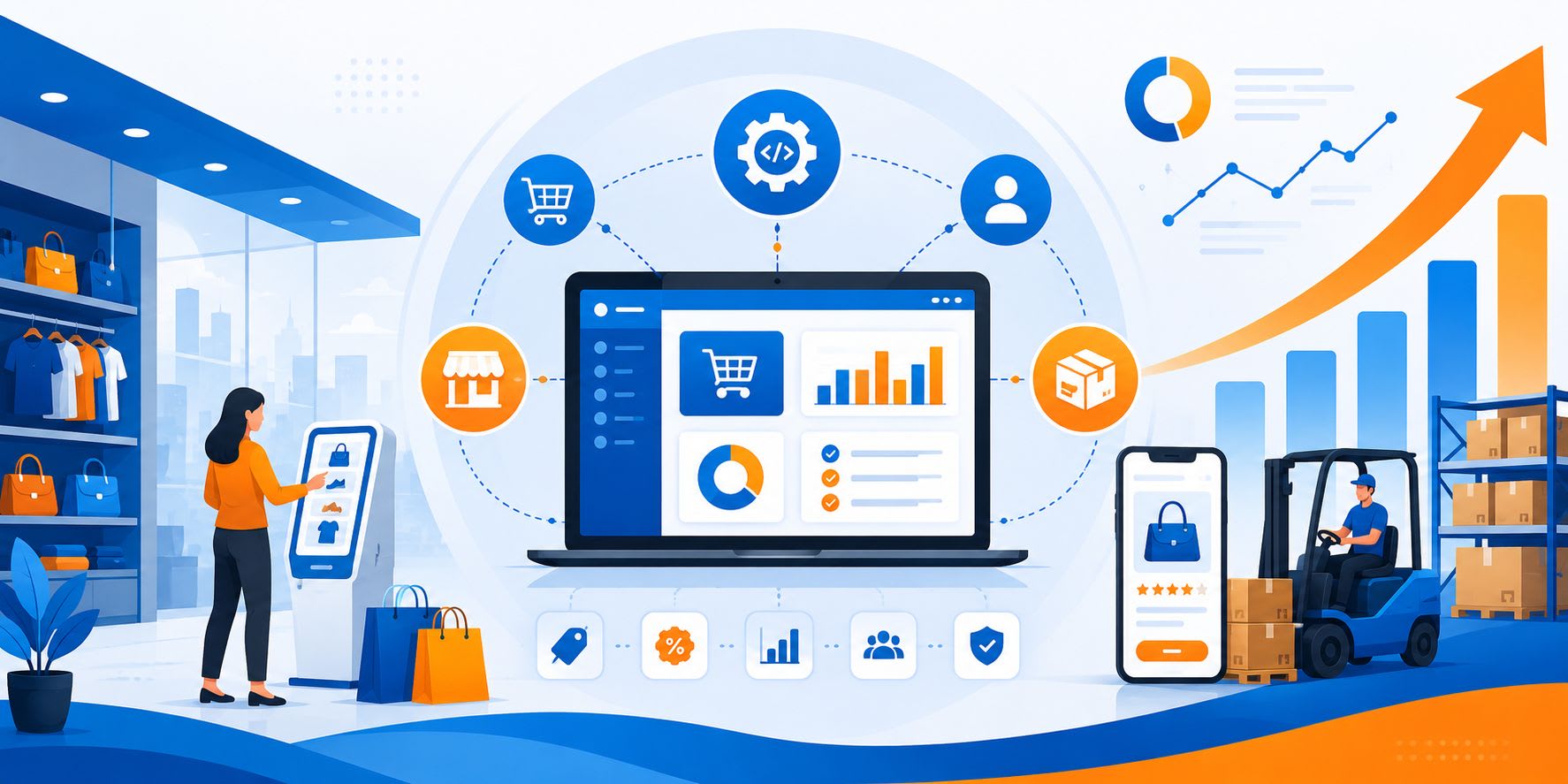
Custom retail software solves these problems by connecting systems and workflows into a unified digital environment. Instead of relying on fragmented tools, retailers can build solutions that match how their business actually works. This can include custom order management, real-time inventory tracking, automated replenishment, personalized marketing, supplier management, employee scheduling, customer segmentation, and advanced reporting.
The result is a more flexible and efficient operation. Teams spend less time fixing errors and more time improving service. Managers gain access to accurate data. Customers receive faster and more reliable experiences. Most importantly, the business becomes better prepared to scale.
The Role of Retail Software in Omnichannel Commerce
Modern retail is no longer limited to one sales channel. A customer may discover a product on social media, compare prices on a website, visit a physical store to see it in person, purchase it through a mobile app, and return it through a pickup location. Every step should feel connected. If the experience is inconsistent, customers may lose trust and choose a competitor.
Omnichannel commerce depends on strong software architecture. Retailers need systems that synchronize product information, pricing, promotions, inventory, orders, payments, customer profiles, and support interactions across every channel. Without this synchronization, common problems appear quickly. A product shown as available online may actually be out of stock. A customer service representative may not see the full order history. A loyalty discount may work in-store but not online. These issues damage customer satisfaction and reduce revenue.
Custom retail software helps create a seamless omnichannel experience. It can connect eCommerce platforms, POS systems, CRM tools, mobile applications, ERP systems, payment providers, logistics platforms, and marketing automation tools. With the right integrations, retailers can provide consistent product data, real-time inventory visibility, unified customer profiles, and flexible fulfillment options such as buy online, pick up in store, ship from store, and same-day delivery.
This kind of experience is no longer optional for many retail businesses. Customers have become accustomed to convenience and speed. They expect retailers to know their preferences, remember their past purchases, and provide accurate information instantly. Businesses that invest in omnichannel software are better positioned to meet these expectations and build long-term loyalty.
Key Types of Retail Software Solutions
Retail software development can cover many types of digital products, depending on business needs. Some companies need a single specialized application, while others require a complete ecosystem of connected platforms. The most valuable solutions are usually those that address specific operational pain points and create measurable business improvements.
One of the most important types of retail software is a custom eCommerce platform. While many businesses use standard online store builders, custom platforms allow for greater flexibility in design, performance, checkout logic, product catalog structure, pricing rules, and integrations. This is especially useful for retailers with complex catalogs, subscription models, personalized products, or multiple customer segments.
Another critical solution is inventory management software. Poor inventory visibility can lead to stockouts, overstocking, lost sales, and unnecessary storage costs. A custom inventory system can track products in real time across warehouses, stores, suppliers, and sales channels. It can also support demand forecasting, automated purchase orders, barcode scanning, batch tracking, and stock transfer management.
Point-of-sale software is also central to retail operations. A modern POS system does more than process transactions. It can connect with loyalty programs, customer profiles, inventory databases, staff performance reports, and accounting systems. For retailers with physical locations, a custom POS can improve checkout speed, reduce errors, and provide valuable sales insights.
Customer relationship management software is another powerful tool. Retailers collect large amounts of customer data, but that data only becomes valuable when it is organized and actionable. A custom CRM can help businesses segment customers, personalize communication, track purchase behavior, manage loyalty programs, and improve retention.
Retail analytics platforms are increasingly important as well. Data-driven decision-making can help companies identify best-selling products, understand seasonal trends, monitor marketing performance, optimize pricing, and forecast demand. Custom dashboards can present the exact metrics that matter to each department, from executive leadership to store managers and marketing teams.
How Custom Retail Software Improves Customer Experience
Customer experience is one of the strongest competitive factors in retail. Price and product selection still matter, but convenience, personalization, and trust often determine whether customers return. Custom software can improve the customer journey at every stage.
Before a purchase, software can help customers discover relevant products through personalized recommendations, intelligent search, filters, and targeted promotions. During the purchase process, it can simplify checkout, support multiple payment options, calculate accurate shipping costs, and apply discounts automatically. After the purchase, it can provide order tracking, automated updates, easy returns, and personalized follow-up messages.
A strong customer experience also depends on consistency. If a customer contacts support, the team should be able to see the full context: previous orders, open tickets, loyalty status, preferences, and recent interactions. Custom software can centralize this information, allowing employees to provide faster and more helpful service.
Personalization is another major advantage. Retailers can use customer data to create more relevant shopping experiences. For example, a fashion retailer can recommend products based on size, style preferences, location, and past purchases. A grocery retailer can suggest frequently purchased items or build smart shopping lists. A beauty retailer can provide product recommendations based on skin type, purchase history, or customer goals.
When done well, personalization does not feel intrusive. It feels useful. Customers appreciate brands that save them time and understand their needs. Custom retail software makes this possible by turning data into meaningful experiences.
Operational Efficiency and Automation
Behind every great retail experience is a complex operational system. Orders must be processed, inventory must be updated, suppliers must be managed, employees must be scheduled, payments must be reconciled, and deliveries must be coordinated. When these processes rely too heavily on manual work, businesses face delays, errors, and higher costs.
Automation is one of the biggest benefits of custom retail software. Routine tasks can be handled automatically, freeing employees to focus on higher-value work. For example, software can automatically generate purchase orders when stock reaches a certain threshold. It can update inventory after each sale, send order confirmation emails, assign delivery tasks, produce financial reports, and notify managers about unusual sales patterns.
Automation also improves accuracy. Manual data entry is one of the most common sources of operational mistakes. A small error in inventory data can create major problems, especially when products are sold across multiple channels. By connecting systems and automating data flow, retailers can reduce mistakes and improve reliability.
For growing companies, automation is especially important. Processes that work for a small team may break down as order volume increases. Custom software allows businesses to scale operations without increasing manual workload at the same rate. This helps maintain service quality while controlling costs.
The Importance of Data in Retail Software
Retail businesses generate data constantly. Every transaction, website visit, product search, abandoned cart, support request, promotion, return, and delivery creates information. The challenge is not collecting data. The challenge is making sense of it.
Custom retail software can help businesses organize data and turn it into actionable insights. Instead of relying on scattered reports from different tools, retailers can build centralized dashboards that show real-time performance across the business. Leaders can track revenue, margins, inventory turnover, customer lifetime value, conversion rates, return rates, and marketing performance in one place.
Data can also improve forecasting. By analyzing historical sales, seasonality, promotions, regional demand, and customer behavior, retailers can make smarter purchasing and inventory decisions. Better forecasting reduces waste, improves product availability, and protects margins.
In addition, data supports better marketing. Retailers can identify high-value customer segments, understand which campaigns generate revenue, and create more relevant offers. Instead of sending the same message to every customer, businesses can personalize communication based on behavior and preferences.
However, data must be handled responsibly. Retail software should be built with strong security, privacy, and compliance practices. Customers trust retailers with personal and payment information, and protecting that data is essential for maintaining reputation and avoiding legal risk.
Choosing the Right Retail Software Development Partner
Selecting the right development partner is one of the most important decisions a retailer can make. The ideal partner should understand both technology and retail operations. They should be able to analyze business needs, identify process gaps, design scalable architecture, build user-friendly interfaces, integrate third-party systems, and provide long-term support.
A strong partner will not simply write code based on a list of requested features. They will ask strategic questions. What problems should the software solve? Which workflows create the most friction? Which systems need to communicate with each other? What data matters most? How will the business scale in the next few years? What risks should be addressed early?
Companies like Zoolatechwork with businesses to build software solutions that are practical, scalable, and aligned with real business goals. In retail, this approach is especially valuable because technology must support both customer-facing experiences and internal operations. A well-built platform should not only look good but also perform reliably, integrate smoothly, and help the business grow.
When evaluating a software development company, retailers should look for experience with complex integrations, cloud-based architecture, data engineering, quality assurance, security, and product strategy. For data-heavy retail systems, that often means bringing in Databricks experts for data engineering who can build and maintain the pipelines that keep inventory, sales, and customer data flowing reliably. Communication is also essential. Retail software projects often involve multiple stakeholders, including executives, store managers, warehouse teams, marketing departments, finance teams, and customer support. A good development partner can translate business needs into technical solutions and keep everyone aligned throughout the project.
Future Trends in Retail Software Development
Retail technology continues to evolve. Businesses that want to stay competitive should pay attention to emerging trends and consider how they fit into their strategy.
Artificial intelligence is already changing retail in areas such as product recommendations, demand forecasting, customer support, fraud detection, and dynamic pricing. AI-powered tools can help retailers understand customer behavior, automate decisions, and improve efficiency. However, AI works best when it is supported by clean data and well-integrated systems.
Mobile commerce is another major trend. Customers increasingly expect fast, intuitive mobile experiences. Retailers often collaborate with a specialized mobile app design agency to create seamless applications for shopping, loyalty programs, in-store navigation, digital receipts, and customer support. Employees can also benefit from mobile tools for inventory checks, task management, and clienteling.
Headless commerce is becoming more popular as well. This approach separates the frontend customer experience from the backend commerce engine, giving retailers more flexibility to create unique digital experiences across websites, apps, kiosks, and other channels.
Sustainability and transparency are also influencing retail software. Customers want more information about product origins, ethical sourcing, environmental impact, and delivery options. Software can help retailers track and communicate this information more effectively.
Another important trend is advanced personalization. As competition grows, generic shopping experiences become less effective. Retailers that use data responsibly to create relevant, helpful, and personalized interactions can increase customer loyalty and revenue.
Conclusion
Retail success today depends on much more than having good products. Businesses need efficient operations, accurate data, connected channels, secure systems, personalized customer experiences, and the flexibility to adapt quickly. Custom retail software development provides the foundation for all of these goals.
By investing in tailored solutions, retailers can reduce manual work, improve inventory accuracy, streamline order management, strengthen customer relationships, and make better business decisions. Whether the goal is to modernize legacy systems, build a new eCommerce platform, connect online and offline channels, or create a data-driven retail ecosystem, custom software can deliver long-term value.
The right technology partner can make this transformation smoother and more effective. A company such as Zoolatech can support retailers in building scalable, reliable, and business-focused software solutions that meet today’s needs while preparing for future growth.
In a market where customer expectations continue to rise, retail companies cannot afford disconnected systems and outdated workflows. They need software that helps them move faster, serve customers better, and operate with confidence. Custom retail software is not just a technical upgrade. It is a strategic investment in the future of the business.
Want to publish a guest post on aamax.co?
Place an order for a guest post or link insertion today.
Place an Order