

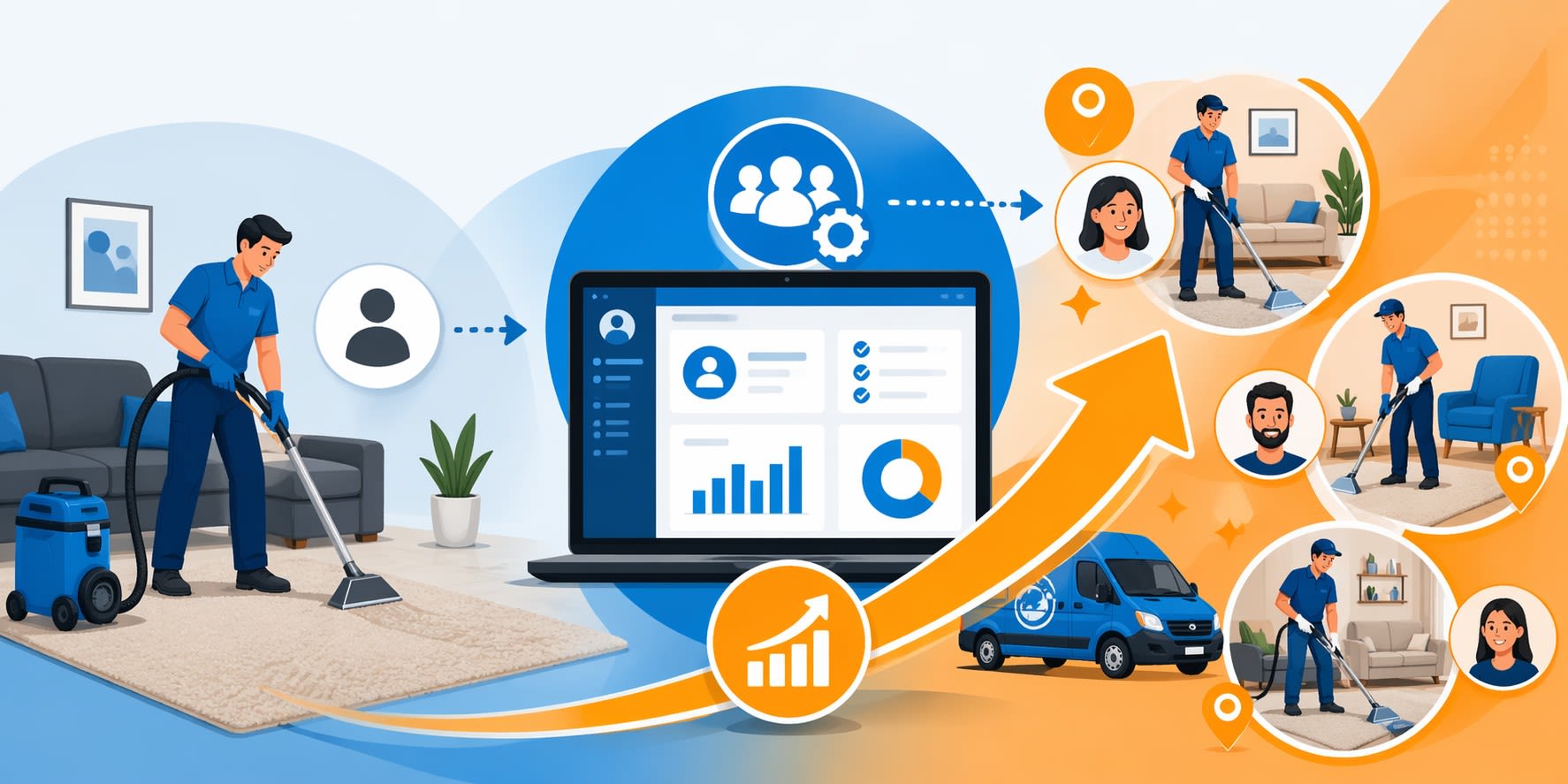
How a CRM Doubles Repeat Jobs for Carpet Cleaning Businesses
Carpet cleaning companies do not usually struggle because they cannot do the work. They struggle because too much of the business lives in memory, text threads, old invoices, and sticky notes. I have seen good operators lose easy repeat jobs simply because nobody followed up at the right time, nobody remembered what was done last visit, or the office had no clean way to reconnect with past customers.
That is why I like this topic so much. A CRM is not just another piece of software to pay for. In a carpet cleaning business, it can become the part of the operation that keeps customers from slipping away after the first service. In this guide, I will show how a CRM for carpet cleaners helps turn one time jobs into repeat revenue, where the biggest losses happen, and what changes first when the system is set up the right way.
Why repeat jobs matter more than most owners think
The first job is expensive. You pay for ads, referrals, local SEO, truck wraps, phone time, estimates, scheduling, and all the little things that go into getting one customer to say yes. The second job is cheaper. The trust is already there. The home is familiar. The customer already knows what to expect. That means every repeat booking usually carries better margin than the first one.
The problem is that many carpet cleaning companies still treat repeat work like a bonus instead of a process. They wait for the customer to remember. They hope the client will call back before the holidays. They assume the property manager will reach out again when the next unit turns over. Sometimes that works. Most of the time, it leaves money sitting on the table.
The broader customer behavior data backs this up. Jobber’s 2025 Home Service Economic Report says nearly half of home service transactions are now digital, which tells me customers expect faster, more organized interactions than they did a few years ago. Zendesk reports that 72 percent of customers want immediate service and 70 percent expect whoever they talk to to have full context. Attentive found that 81 percent of consumers ignore irrelevant messages, while 90 percent want more personalized communication than they currently get. Those are not abstract trends. They describe the exact pressure carpet cleaning businesses feel every day.
What the current numbers mean in plain English
The raw numbers are useful, but only if they connect to daily work. Here is how I read them as an operator or marketer looking at a carpet cleaning business.
| Verified 2025 to 2026 data point | Current figure | What it means for a carpet cleaning company |
|---|---|---|
| Home service transactions that are digital | Nearly 50% | Customers are comfortable booking, paying, and communicating digitally. Slow manual follow up stands out in a bad way. |
| Customers who want immediate service | 72% | The faster I respond to an inquiry or rebooking request, the better my odds of closing the job. |
| Customers who expect full context | 70% | Repeat clients expect me to know what happened last time without asking them to repeat the whole story. |
| Consumers who ignore irrelevant messages | 81% | Generic reminders are easy to skip. Specific reminders work better. |
| Consumers who want more personalized communication | 90% | Timely follow up tied to service history feels more helpful and gets more attention. |
These numbers point to one simple truth. Carpet cleaning businesses do not just need more leads. They need better memory, cleaner follow up, and faster communication. That is exactly where a CRM earns its keep.
Where repeat jobs usually get lost
I do not think most businesses lose repeat work in one dramatic moment. It usually happens through small misses that pile up.
The first miss comes right after the job. The crew leaves. The payment comes through. The day moves on. No thank you message goes out. No review request gets sent. No reminder is scheduled for six months later. The customer may have loved the service, but the business never gives them a reason to come back at the right time.
The second miss happens during quoting. A past customer calls and asks for the same three rooms plus stairs. If the office has to hunt through old emails or call the technician to rebuild the job history, that quote gets slower and shakier. People notice that. When customers want quick answers, a messy system makes the company feel less dependable than it really is.
The third miss happens in the message itself. Too many businesses send reminders that sound like they were written for nobody in particular. “We miss you. Book now.” That kind of message gets ignored because it does not feel useful. A reminder that says, “It has been about six months since we cleaned your upstairs bedrooms and hallway. Want to get ahead of back to school traffic?” lands differently. It sounds like a real business talking to a real customer.
What a CRM changes inside the business
A carpet cleaning CRM does more than store names and phone numbers. It gives the business a memory that does not disappear when the office gets busy.
When I use a system like that properly, I can see which rooms were cleaned, what the customer bought, whether stain treatment was added, which technician handled the job, when the invoice was sent, and when the next reminder should go out. That changes how the business operates because every future conversation starts with context instead of guesswork.
Here is the difference in practical terms.
| Without a CRM | With a CRM |
|---|---|
| Customer history is spread across phones, inboxes, and paper notes | Customer history lives in one record |
| Quotes for returning clients take longer | Quotes can be rebuilt from past job details |
| Follow up depends on memory | Follow up runs on schedule |
| Repeat business feels random | Repeat business becomes predictable |
| Staff asks the customer to repeat details | Staff can pick up where the last job ended |
That is why I see CRM as an operations tool first and a marketing tool second. Marketing gets the customer in the door. The CRM gives the business a better shot at keeping that customer for the next job.
How this can realistically double repeat jobs
I do not need a wild claim to explain the math. The lift can come from simple retention gains.
Let’s say a carpet cleaning business serves 200 unique customers over a year. If only 15 percent of them rebook, that turns into 30 repeat jobs. If better reminders, cleaner notes, and faster quoting push that rebooking rate to 30 percent, the business gets 60 repeat jobs instead of 30. That is a doubling of repeat work without doubling lead costs.
| Example customer base | Rebooking rate | Repeat jobs generated |
|---|---|---|
| 200 customers | 15% | 30 |
| 200 customers | 20% | 40 |
| 200 customers | 25% | 50 |
| 200 customers | 30% | 60 |
I like this example because it stays grounded. It does not assume a miracle. It assumes the business already does solid work and simply gets better at staying in touch. In a lot of carpet cleaning companies, that alone is enough to create a noticeable jump in repeat revenue.
The CRM workflows that matter most
The first workflow I want is automatic rebooking reminders. Carpet cleaning is timing based. Some homes need service every few months. Others are seasonal. Property managers may need help around turnovers. A CRM lets me tie the follow up to the actual service pattern instead of sending random blasts.
The second workflow is saved job history. This matters more than people think. If I know a customer had pet odor treatment in the family room, plus traffic lane issues on the stairs, I can speak with confidence the next time they call. I am not asking them to start over. I am showing them I remember the property.
The third workflow is quote follow up. A lot of revenue dies quietly after estimates go out. If a customer asked for pricing and never replied, the system should bring that lead back to the surface so the office can follow up while the need is still fresh.
The fourth workflow is review collection tied to job completion. Good reviews help future lead generation, but they also support retention. Customers trust businesses that look active, current, and organized online.
The fifth workflow is win back outreach. Some past customers do not need convincing. They just need a smart reminder. A CRM makes it easy to identify clients who booked before but have gone quiet.
This is one reason platforms like Smarfle stand out in the local service space. It is built around the daily realities of scheduling, client history, invoices, and job follow up for service businesses, which is exactly what a carpet cleaning company needs when it wants repeat work to feel less accidental and more controlled.
What to look for before choosing a system
Not every CRM fits a carpet cleaning business. I would look for software that handles scheduling, quoting, invoices, customer notes, technician visibility, and repeat reminders in one place. If those parts are split between too many tools, the business ends up right back in the same mess, only now it is paying monthly for it.
I would also want the system to be simple enough for the team to use consistently. That matters a lot. Even a good platform fails if the office avoids it and the field team never updates records. If I were comparing options, I would want a CRM for carpet cleaners that keeps job history, reminders, and day to day workflow in one clean system instead of forcing the team to bounce between disconnected apps.
A practical first month plan
I would keep the rollout simple. First, import every customer from the last twelve months. Second, tag them by service pattern such as residential maintenance, move out cleaning, commercial account, or pet treatment. Third, build three basic automations that actually matter: a thank you message after service, a review request after the job, and a timed reminder for the next likely booking window.
That is enough to create movement fast. It gives the business a better memory, a better follow up rhythm, and a much cleaner way to turn old customers into new jobs.
The real takeaway
I do not think carpet cleaning businesses need more chaos in the name of growth. They need fewer dropped details. They need a better way to remember people, follow up on time, and make repeat booking feel easy for the customer.
That is why a CRM can double repeat jobs. Not because software performs magic, but because it closes the gaps that quietly cost the business money every week. When the system remembers the customer, the business gets another chance to serve them. And in carpet cleaning, that second chance is often where the profit gets much better.
Want to publish a guest post on aamax.co?
Place an order for a guest post or link insertion today.
Place an Order