


How AI Humanizer Tools Help Content Pass AI Detection
AI writing assistants like ChatGPT, Claude, and Gemini have become everyday tools for bloggers, marketers, students, and businesses. They save hours of work — but they also leave a fingerprint. AI detectors such as ZeroGPT, GPTZero, and Originality.ai can flag machine-generated text, which can hurt your credibility, your grades, or your search rankings.
That's where AI humanizer tools come in. In this article, we'll explain how AI detectors work, why AI-generated text gets flagged, and how humanizer tools rewrite content so it reads — and scans — as genuinely human.
How AI Detectors Actually Work
AI detectors don't "know" whether a human or a machine wrote something. Instead, they analyze statistical patterns in the text and estimate the probability that it was machine-generated. The two most important signals are:
- Perplexity — how predictable the word choices are. Large language models tend to pick the most statistically likely next word, so AI text is often too smooth and too predictable. Human writing is messier and more surprising.
- Burstiness — how much sentence length and structure vary. Humans naturally mix short punchy sentences with long, winding ones. AI models tend to produce sentences of similar length and rhythm.
Detectors also look for telltale AI phrasing: overused transitions ("furthermore," "moreover," "it is important to note"), perfectly parallel structures, hedge-heavy conclusions, and an overly formal, neutral tone.
Why AI-Generated Content Gets Flagged
Even well-edited AI drafts often trip detectors because:
- Uniform sentence rhythm — every sentence lands in the same 15–25 word range.
- Predictable vocabulary — the model always reaches for the "safest" word.
- Formulaic structure — intro, three neat body points, and an "in conclusion" wrap-up.
- Robotic transitions — "additionally," "furthermore," "ultimately" appearing like clockwork.
- No personal texture — no opinions, anecdotes, idioms, or small imperfections.
Light manual editing rarely fixes all five at once. That's the gap humanizer tools are built to close.
What AI Humanizer Tools Do
An AI humanizer takes machine-generated text and rewrites it at the sentence level to restore human statistical patterns. A good humanizer will:
- Vary sentence length and structure to increase burstiness
- Swap predictable words for natural, less statistically obvious alternatives
- Break formulaic patterns — reorder ideas, merge or split sentences
- Remove AI clichés like "in today's fast-paced world" and "it is important to note"
- Preserve the original meaning so your message stays intact
- Keep the text readable — a humanizer that produces gibberish defeats the purpose
The best tools are trained on large corpora of real human writing, so the output doesn't just dodge detectors — it genuinely reads better.
A Real Example: Humanizing Text with TextCleaner
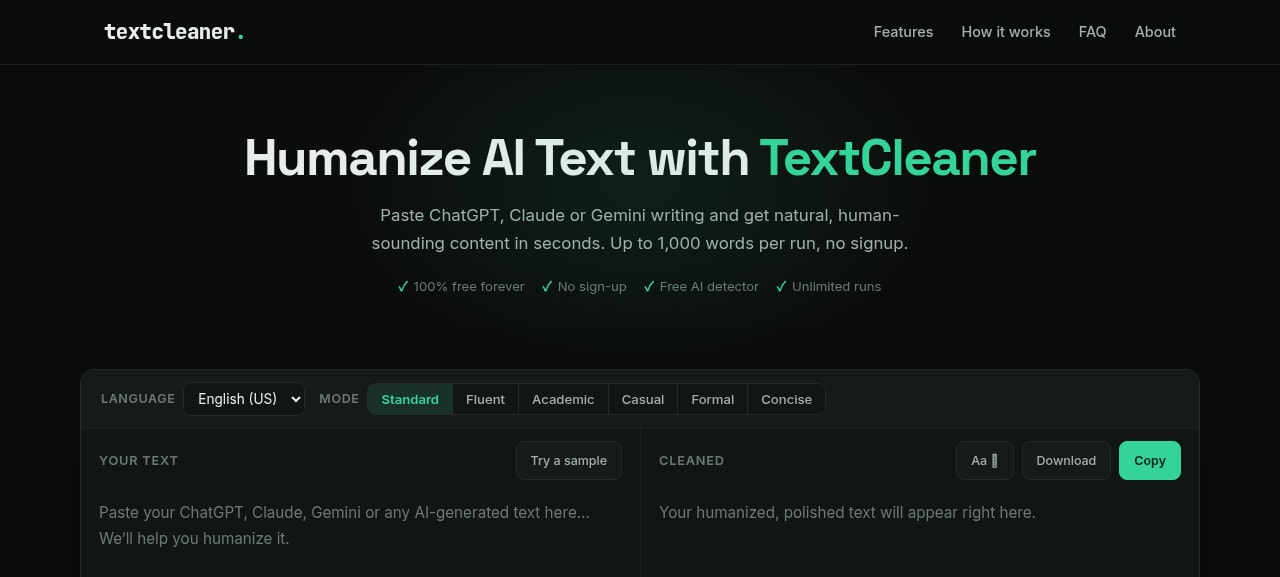
To show how this works in practice, we ran a real test using TextCleaner, a free AI humanizer that requires no signup and supports up to 1,000 words per run with multiple rewriting modes (Standard, Fluent, Academic, Casual, Formal, and Concise).
Step 1: Start with an AI-generated paragraph
We asked an AI model to write a typical paragraph about remote work. It came out exactly how you'd expect — polished, formal, and full of classic AI tells like "unprecedented flexibility," "it is important to note," and "furthermore."
Step 2: Run it through the humanizer
We pasted the paragraph into TextCleaner, selected the Standard mode, and clicked Humanize. In a few seconds, the tool rewrote the text with varied sentence lengths, more natural word choices, and none of the robotic transitions — while keeping every original point intact.
Step 3: Verify with ZeroGPT
We then took the humanized output and ran it through ZeroGPT, one of the most widely used free AI detectors. The result:

0% AI GPT — "Your Text is Human written." The humanized text passed cleanly, with no sentences flagged.
Best Practices When Using an AI Humanizer
Humanizer tools are powerful, but you'll get the best results if you treat them as part of a workflow rather than a magic button:
- Always fact-check the output. Humanizers rewrite style, not accuracy. If the AI draft contained an error, the humanized version will too.
- Read the result out loud. If a sentence sounds awkward, fix it manually. Your judgment is the final quality gate.
- Add something only you can add. A personal example, a specific number, or a firsthand opinion makes content both more human and more valuable.
- Test with a detector before publishing. A quick check with ZeroGPT or a similar tool takes seconds and confirms your text scans as human.
- Use humanizers ethically. They're best used to polish AI-assisted drafts you'd stand behind — not to misrepresent authorship where original human work is explicitly required.
Why This Matters for SEO and Content Marketing
Search engines reward content that's helpful and written for people. Text that reads like a template — even if technically accurate — engages readers poorly, and poor engagement signals hurt rankings. Humanized content tends to have:
- More natural keyword integration instead of forced repetition
- Better readability and lower bounce rates
- A distinct voice that builds brand trust
- A lower risk of being algorithmically devalued as mass-produced content
In other words, passing AI detection isn't just about the score — it's a proxy for writing that actually connects with readers.
Final Thoughts
AI detectors flag text based on statistical patterns: low perplexity, low burstiness, and formulaic phrasing. AI humanizer tools reverse those patterns, rewriting machine drafts so they carry the natural variety and texture of human writing.
As our test showed, a single pass through a quality humanizer like TextCleaner turned a flagged-prone AI paragraph into text that scored 0% AI on ZeroGPT. Combine that with fact-checking and a personal touch, and you get content that satisfies both detectors and — more importantly — real readers.
Want to publish a guest post on aamax.co?
Place an order for a guest post or link insertion today.
Place an Order